



Why Switching to SIP Trunking Can Transform Your Business
Modern businesses rely on fast, reliable communication to stay competitive. Traditional phone systems are expensive, slow, and rigid, especially for companies with remote teams or multiple office locations. SIP trunking solves these problems by connecting your business phone system to the internet.
Voice calls, video conferences, and messages travel through a single, secure IP connection. This reduces infrastructure costs, improves call quality, and simplifies management. Businesses can handle multiple client calls at once, support remote employees, and scale their communication system without downtime.
For example, a company operating in three cities reduced communication costs by over 60% after switching to SIP trunking while improving customer service reliability.
How SIP Trunking Cuts Communication Costs
Communication expenses can take a surprisingly large portion of a business budget, especially for small and medium enterprises. Traditional phone systems rely on multiple physical lines, each with rental fees, maintenance costs, and extra charges for long-distance or international calls. These hidden costs add up quickly and often go unnoticed until the monthly bills arrive.
SIP trunking replaces these old phone lines with an internet-based system. By transmitting calls, video meetings, and messages over a single IP connection, it removes the need for multiple lines and reduces recurring costs. Businesses only pay for the channels they actually use, which makes costs predictable and controllable.
Specific ways SIP trunking reduces expenses include:
- Eliminating multiple line rentals: One internet connection can handle many simultaneous calls, removing the need to rent a separate line for each extension.
- Lowering international call charges: Because SIP calls travel over the internet, international communication is often a fraction of the cost of traditional phone lines.
- Reducing maintenance costs: There’s no complex wiring or hardware to maintain, and upgrades are managed through software instead of manual installation.
- Real-time monitoring: Cloud-based dashboards allow businesses to track call usage, identify unnecessary expenses, and adjust channels according to actual needs.
For example, a medium-sized business with three offices was able to cut its monthly communication bill by 60% after switching to SIP trunking. They also gained better call quality, faster setup for new lines, and simplified management, which freed IT staff to focus on other critical tasks. Many SMEs report 50–70% savings in monthly phone bills immediately after adopting SIP trunking.
How SIP Trunking Works for Businesses
- Your existing PBX or cloud phone system connects to the internet through a SIP trunk provider.
- Calls route over the internet instead of traditional phone lines, reducing cost.
- Local and international numbers can be maintained without additional hardware.
- Channels and call features are managed via cloud dashboards.
With proper configuration, SIP trunking improves call quality, ensures reliability, and provides the flexibility needed for modern business operations.
Business SIP Trunking vs Traditional Phone Systems
| Feature | Traditional PBX Lines | SIP Trunking for Business |
|---|---|---|
| Cost | High rental and long-distance fees | Lower, predictable monthly cost |
| Scalability | Limited, requires physical installation | Instant scaling via software |
| Management | Hardware-based, manual | Cloud-based with dashboards |
| Failover | Minimal | Automatic rerouting during outages |
| International Calls | Expensive | Low-cost, internet-based |
This comparison highlights how business SIP trunking solutions can transform communication efficiency while reducing operational costs.
Implementation Strategy for SIP Trunking Solutions
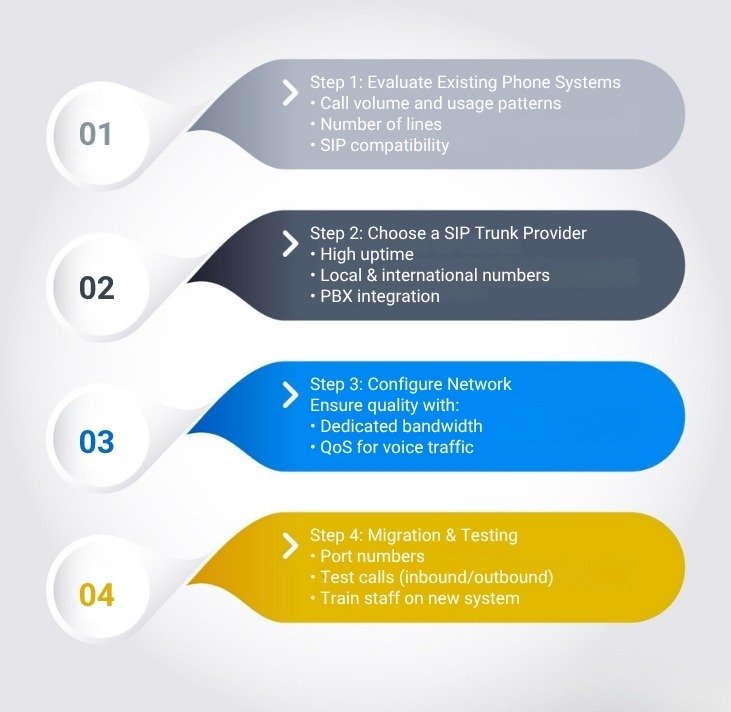
Step 1: Evaluate Existing Phone Systems
Before switching, analyze:
- Call volumes and patterns
- Number of physical lines
- Compatibility with SIP trunk providers
Step 2: Choose a Trusted SIP Trunk Provider
Select a provider that offers:
- High network uptime
- Local and international number support
- Integration with your PBX systems
- Clear, no-hidden-cost pricing
Step 3: Configure Network for SIP Traffic
Ensure call quality by:
- Providing dedicated bandwidth
- Using Quality of Service (QoS) for prioritizing voice traffic
- Testing for latency, jitter, and packet loss
Step 4: Migration and Testing
- Port existing numbers
- Test inbound and outbound calls
- Train staff on features and new interfaces
Cost Savings Comparison
Understanding how much your business can save requires a clear comparison between traditional phone systems and SIP trunking. Traditional PSTN lines often come with hidden costs like monthly rentals, maintenance, and expensive international calls. These expenses can quickly add up, especially for small and medium businesses that rely on frequent communication with clients across different regions.
Switching to SIP trunking eliminates many of these costs. By routing calls over the internet and using flexible, cloud-managed channels, businesses can reduce expenses while improving call reliability and scalability. The table below illustrates the difference in monthly costs and potential savings:
| Communication Type | Monthly Cost | Savings with SIP Trunking | Notes |
|---|---|---|---|
| Traditional PSTN Lines | $500 | – | Physical line rental & maintenance |
| International Calls | $300 | Up to 90% | Calls routed over internet |
| Business SIP Trunking | $150 | $650+ | Flexible channels and cloud management |
As you can see, SIP trunking not only reduces monthly expenses significantly but also provides flexibility that traditional systems cannot offer. Businesses can adjust channels as needed, manage lines through cloud dashboards, and avoid unnecessary maintenance costs.
Core Cost-Saving Mechanisms
Saving on business communication is not just about lowering bills—it’s about creating a system that is efficient, flexible, and scalable. SIP trunking achieves this by consolidating multiple services into a single platform, reducing the need for separate phone lines, complex hardware, and expensive international calling plans.
By focusing on the core cost-saving mechanisms, businesses can identify exactly where money is being spent and take steps to optimize usage. This includes streamlining the number of lines, paying only for the channels required, leveraging internet-based calling for long-distance communication, and supporting remote teams without extra infrastructure.
Implementing these mechanisms ensures that every dollar spent on communication adds value, rather than going to unnecessary maintenance, outdated systems, or redundant services.
SIP trunking saves money through several key mechanisms:
| Mechanism | How It Saves Money | Actionable Tip |
|---|---|---|
| Consolidation of Lines | Replaces multiple physical lines with one IP-based system | Audit existing lines and consolidate redundant connections |
| Internet-Based Calling | Low-cost local and international calls | Compare international call rates and switch to SIP for savings |
| Pay-As-You-Go Channels | Add or remove channels based on usage | Adjust channels seasonally to optimize costs |
| Remote Team Support | No extra infrastructure needed | Train staff to use SIP features from home or remote offices |
| Minimal Hardware Investment | Reduces PBX upgrades or wiring expenses | Use cloud dashboards for easy system management |
Regularly reviewing usage and adjusting channels ensures maximum cost efficiency.
How Almens Consult Simplifies SIP Trunking
Almens Consult helps businesses implement SIP trunking efficiently and confidently:
- Evaluate existing communication systems and costs
- Recommend the most suitable SIP trunk solution
- Configure networks for optimal call quality
- Migrate numbers without downtime
- Train teams to manage the system effectively
Partnering with experts ensures faster adoption, reliable performance, and measurable cost reductions.
Ready to Switch?
SIP trunking for business provides cost savings, scalable communication, and reliable connectivity. Implementing business SIP trunking phone systems allows businesses to integrate modern collaboration tools, manage calls efficiently, and expand easily.
By auditing your current system, selecting a reliable provider, planning migration carefully, and training staff, SMEs can implement SIP trunking quickly and confidently. This results in immediate savings, improved efficiency, and a future-ready communication system.
With Almens Consult’s expertise, companies can adopt SIP trunking solutions confidently, achieving measurable savings, improved call quality, and future-ready communication infrastructure.
Frequently Asked Questions (FAQs)
What is SIP trunking?
SIP trunking connects your phone system to the internet for voice, video, and messaging.
How does SIP trunking save money?
It reduces line rentals, long-distance charges, and maintenance costs.
Can SIP trunking work with my current PBX?
Yes, most PBX systems are compatible via adapters or cloud-based integration.
What is a SIP trunk provider?
A company that delivers SIP trunking services, managing call routing and connectivity.
Does SIP trunking support international calls?
Yes, SIP trunking supports local and international numbers at low cost.
Is SIP trunking secure?
Yes, with TLS/SRTP encryption and firewalls, communications are safe.
Can SIP trunking support remote teams?
Absolutely. Channels can be accessed anywhere with an internet connection.
How quickly can my business switch to SIP trunking?
Migration usually takes a few days to weeks depending on complexity.
Can SIP trunking integrate with CRM systems?
Yes, it integrates with platforms like Salesforce, Teams, and Slack.
Will SIP trunking improve call quality?
Yes, if properly configured with QoS and adequate bandwidth.