




Managing multiple phone lines, ports and invoices in-house quickly becomes a distraction for any organisation that wants to focus on its core work. Managed Telephony Services move that burden off your shoulders. By centralising configuration, monitoring and support with a single provider, businesses gain predictable costs, faster fixes and more resilient voice services without needing to become telecoms experts.
The legacy problem: why DIY phone lines fail businesses
Many organisations still rely on a mixture of legacy providers, ageing on-prem equipment and ad hoc mobile contracts. Problems typically include:
- Fragmented ownership across suppliers.
- Unexpected engineering charges and long wait times for fixes.
- Complex number porting and risk of downtime during migrations.
These issues distract IT teams, cause customer frustration and hide the true cost of ownership. Using piecemeal solutions like traditional Phone System setups often compounds the problem.
What managed telephony services actually do
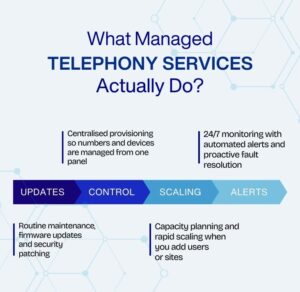
A managed telephony provider handles every aspect of your voice service lifecycle. Core capabilities include:
- Centralised provisioning so numbers and devices are managed from one panel.
- 24/7 monitoring with automated alerts and proactive fault resolution.
- Routine maintenance, firmware updates and security patching.
- Capacity planning and rapid scaling when you add users or sites.
Technology components, simply explained
Most modern managed telephony solutions run on Hosted Phone Systems that replace the need for a physical PBX. Calls are routed via session controllers and redundant data centres to maintain continuity. Providers design failover paths so calls route over a secondary link if a primary connection fails. Think of it as a resilient, remotely managed switching environment that removes hardware chores from your office.
Benefits you can measure
Switching to a managed model delivers measurable business benefits:
- Predictable monthly costs and fewer surprise engineering bills.
- Faster mean time to repair and fewer customer-facing outages.
- Quicker onboarding for new starters and remote workers.
- Single point of accountability for calls, mobiles and connectivity.
Key benefits at a glance:
- Reduced operational overhead
- Better uptime and continuity
- Simpler billing and reporting
- Faster feature rollout
How it differs from traditional options
A managed service is not the same as buying a standard Phone System and asking your IT team to maintain it. It differs in three important ways:
- Accountability: one supplier handles everything rather than several contracts.
- Ongoing service: the provider performs continuous upkeep rather than a one-off install.
- Proactive maintenance: outages are often detected and fixed before users report them.
Integration with other business communications
Managed telephony is designed to work with your collaboration and CRM tools. That includes click-to-dial from customer records, presence status sharing and call recording storage. You can also integrate staff mobiles so they appear as part of the company telephony estate, which keeps customer experience consistent whether calls land on desks or mobile devices.
For organisations with hybrid teams, combining this with Business Mobiles Consultation ensures employees’ mobiles work seamlessly with the main telephony platform.
When to migrate: clear signals
Consider a managed move when:
- You face repeated outages or long engineer lead times.
- You operate multiple sites or a hybrid workforce.
- Your team spends more time troubleshooting phone issues than delivering projects.
A simple cost-and-time comparison often reveals that the subscription model is cheaper than the cumulative cost of DIY support and emergency fixes. Incorporating High-Speed Broadband as part of the setup can also improve resilience and call quality for cloud services.
Migration process: practical checklist
A typical migration follows a predictable sequence:
- Discovery and audit: map numbers, devices and dependencies.
- Design and pilot: validate architecture with a subset of users.
- Porting and cutover: move numbers with minimal downtime.
- Training and documentation: ensure users know the new workflows.
- Post-migration optimisation: fine tune call routing and reporting.
Use this checklist to assign responsibilities and measure progress during the transition. Implementing Voice Over IP Landline integration during migration ensures legacy numbers continue to function without disruption.
Commercial models and SLAs
Most providers offer subscription pricing, sometimes bundling handsets, management and connectivity. Assess proposals for:
- Included hardware and any upfront charges.
- SLA targets such as uptime percentage and response times.
- Escalation procedures and reporting cadence.
A clear SLA protects your operations and sets expectations on restoration times. Adding SIP Trunking can improve call capacity and reliability while reducing per-minute costs.
Common objections and responses
Organisations often worry about losing control or vendor lock-in. A reputable provider will:
- Offer exportable call records and configuration data.
- Provide clear exit terms for number and service porting.
- Demonstrate security controls and data location to meet compliance needs.
In addition, combining services with Business SIP Trunking ensures efficient call routing for multi-site operations.
Quick ROI example
A small office with frequent engineer callouts and split supplier billing often recoups the managed subscription within 6 to 12 months when hidden costs are included. Savings come from reduced emergency engineer fees, lower admin time and fewer lost sales during outages. For companies requiring extensive mobile coverage, deals like Voda Unlimited can also be bundled to reduce mobile expenditure.
Choosing a provider: what to demand
Ask prospective partners for:
- Evidence of multi-site migrations and reference clients.
- Details on redundancy and how they handle an entire site failover.
- Clear pricing that separates one-off fees from ongoing charges.
Never sign before seeing the SLA and the porting plan for your critical numbers. Also, consider Mobile Phone Business Solutions UK when reviewing bundled packages for employees.
Complementary services to consider
When planning a managed telephony strategy, consider related services that will affect performance and cost:
- Business SIP Trunking for efficient call routing and number management.
- High-Speed Broadband options for primary or backup connectivity.
- Business Mobiles Consultation to align mobile and desk telephony.
- Voda Unlimited for unlimited voice plans where applicable.
- SIP Trunking for cost-effective call routing.
- Existing Phone System integrations.
- Legacy Voice Over IP Landline migrations.
Almens Consult: Your Expert Guide to Managed Telephony Success
Almens Consult specialises in assessing legacy telephony estates and designing managed transitions that minimise downtime. They conduct discovery audits, build migration plans and provide ongoing management for organisations that want to move away from in-house line management. For businesses exploring a pilot or full-scale migration, Almens Consult delivers a practical timeline, cost projection and tailored managed service strategy.
Final summary and next steps
The operational and hidden costs of managing phone lines yourself add up. By moving to managed telephony you delegate provisioning, monitoring and problem resolution to specialists. That frees your IT team to focus on strategic work, reduces service interruptions and gives your business a predictable spending model. If your organisation is spending staff time on line faults or juggling multiple vendors, it is time to evaluate a managed provider with demonstrable migration experience. Reach out to a reputable partner for a discovery audit and a realistic migration roadmap.
Managed Telephony Services: FAQs by Almens Consult
What are the top managed telephony service providers in the UK?
BT, Gamma, Virgin Media Business, Vodafone, and 8×8 are among the leading providers.
What are the core components of managed business phone systems?
They typically include call routing, cloud PBX, device management, monitoring, and support.
Which managed telephony services include cloud PBX solutions?
Most providers, including 8×8, Gamma, and Vodafone, offer cloud PBX as part of their managed packages.
How can managed telephony services improve business communication?
They centralise management, reduce downtime, enhance call quality, and enable mobile and remote integration.
What are the benefits of switching to managed telephony services?
Lower costs, predictable billing, improved resilience, faster onboarding, and less IT overhead.