



Many businesses sign mobile contracts reactively, often under pressure from new hires or urgent projects. That reactive approach seems convenient at the time but quickly produces fragmentation in billing, inconsistent service and compliance risks. A proper Business Mobiles Consultation at the outset helps organisations avoid this trap by aligning procurement with business needs, usage patterns and long term strategy. In short, consultancy turns short term convenience into long term value.
What ad-hoc mobile contracts look like in practice
Ad-hoc mobile contracting takes several familiar forms:
- Individual employees buying SIMs or handsets independently
- Departments taking promotional offers without central approval
- Multiple suppliers and renewal dates spread across the business
- No centralised inventory or usage reporting
These behaviours create a tapestry of small decisions that compound into a large, expensive problem.
Why ad-hoc feels flexible and why that is misleading
At a glance, department-level buying looks flexible. Managers can get people connected fast and promotional deals can look attractive. However that speed comes at the cost of consistency. Without governance there is no visibility of total spend, no rightsized tariffs and no supplier leverage. Flexibility turns into unpredictability, and unpredictability increases operating costs.
Cost leakage and billing complexity
Hidden cost drivers from ad-hoc arrangements include:
- Duplicate allowances across teams that waste budget
- Overpaying for unused data bundles and minutes
- Multiple VAT and supplier invoices that increase admin costs
- International roaming charges and a lack of roaming controls
- Time lost reconciling invoices and chasing credits
Organisations that do not centralise procurement cannot easily identify where money is leaking and therefore cannot negotiate effective volume discounts or implement fair use policies.
Inconsistent network performance and coverage issues
When teams use different networks and device types, the user experience varies widely.
- Some field teams may be on a provider with limited rural coverage
- Office-based staff may have poor indoor signal that affects call quality
- Remote workers can be disadvantaged if roaming or tethering is not provisioned
The absence of a coverage strategy undermines reliability and employee productivity.
Security and compliance risks
Mobile devices are an extension of the corporate network and must be treated accordingly. Common security failures include:
- No central mobile device management policy
- Lack of enforced encryption and remote wipe capability
- SIM misuse and unauthorised roaming or purchases
- Weak procedures for decommissioning lost or stolen handsets
For regulated industries, these failures can cause breaches of data protection rules and expose the organisation to reputational and financial harm.
Scalability problems during growth
Ad-hoc contracts hinder rapid scaling. Problems that emerge when a business grows include:
- Slower onboarding of new starters because devices and plans are not pre-staged
- Inflexible tariffs that become costly when usage patterns change
- Difficulty supporting multi-location setups and international expansion
- Gaps in device lifecycle management and replacement schedules
Scalability requires planning, which is what a targeted consultation provides.
The strategic value of Business Mobiles Consultation
A focused Business Mobiles Consultation delivers measurable benefits:
- A full audit of current spend and usage patterns
- Right-sizing of tariffs so the business only pays for what it needs
- Consolidated billing to reduce administrative overhead
- Carrier selection based on coverage and commercial terms
- Device lifecycle planning and replacement budgeting
Most importantly, consultation turns raw data into a managed programme, preventing repeated cycles of ad-hoc purchasing.
How centralised procurement improves cost control
Central procurement creates negotiating leverage and visibility. Key actions include:
- Negotiating volume based discounts and term benefits
- Aligning contract renewal dates to avoid chaos and premium renewals
- Forecasting costs so finance teams can plan with confidence
- Reducing the number of suppliers to simplify supplier management
These measures reduce both direct costs and effort spent on administration.
Aligning mobile strategy with wider communications infrastructure
Mobile must not operate in isolation. A good mobile programme integrates with other systems:
- It should align with the hosted phone systems used in offices
- It needs to support integration with a hosted voip business phone system where appropriate
- Plans for remote and hybrid working should be consistent with the wider Phone System strategy
- Network resilience planning should consider Dedicated Leased Lines and High-Speed Broadband used by core sites
Integration reduces duplication and supports a single, cohesive communications experience for staff and customers.
Case scenario: from ad-hoc chaos to structured mobility
Consider a mid-sized UK firm that faced escalating mobile bills, inconsistent device security and poor field connectivity. After an audit the consultant consolidated five suppliers to two, moved the business to a central billing model, and implemented device management for encryption and remote wipe. The result was lower monthly spend, faster onboarding and a single point of contact for support. This transition shows how measurable savings and service improvements emerge from planning rather than chance.
Addressing technical options and connectivity
When aligning contracts and solutions, review the technical choices carefully:
- Evaluate multi line business phone systems for offices with high inbound traffic
- Check whether Voice Over IP Landline options or SIP Trunking better suit call volumes and PSTN connectivity needs
- Consider Dedicated Leased Lines or High-Speed Broadband for sites requiring guaranteed bandwidth
- Compare hosted phone systems and Hosted VoIP Business Phone System offerings on uptime, support and integration features
Choosing the right technical mix prevents surprises and ensures predictable performance.
Vendor examples and product fit
Vendors and plans vary. For example, some businesses find value in bundles that include roaming and unlimited voice plans such as Voda Unlimited. Others prefer a pure hosted solution that tightly integrates voice and messaging. The important point is to assess vendor offerings against actual usage data and service level expectations rather than headline promotions.
How Almens Consult transforms business mobile strategy
Almens Consult offers an end-to-end Business Mobiles Consultation service tailored to UK organisations. Typical activities include:
- A comprehensive contract and usage audit
- Vendor shortlisting and commercial negotiation support
- Coverage mapping and performance testing for remote teams
- SIP Trunking and Voice Over IP Landline integration where needed
- Device lifecycle planning, procurement management and staged migration support
- Ongoing optimisation with regular cost reviews and reporting
By combining technical knowledge with procurement experience, Almens Consult turns a fragmented mobile estate into a managed strategic asset.
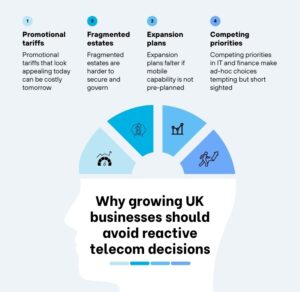
Why growing UK businesses should avoid reactive telecom decisions
Market conditions, employee expectations and data usage patterns are changing rapidly
. Reactive decisions introduce risk:
- Promotional tariffs that look appealing today can be costly tomorrow
- Fragmented estates are harder to secure and govern
- Expansion plans falter if mobile capability is not pre-planned
- Competing priorities in IT and finance make ad-hoc choices tempting but short sighted
A policy of planned procurement and periodic review prevents these problems.
Strategy over short-term deals
Ad-hoc mobile contracts are a common source of wasted budget, security gaps and poor user experience. A Business Mobiles Consultation brings visibility, governance and direction. Whether the business needs multi line business phone systems in large sites, integration with hosted phone systems or reliable backhaul via Dedicated Leased Lines and High-Speed Broadband, planning creates predictable outcomes. The cost of doing nothing is real. Investing in consultation is an investment in operational resilience and measured growth. A structured approach ensures the right commercial terms, the right technical fit and the right security posture for the long run.