



Energy costs continue to rise across the United Kingdom. Commercial building owners face increasing pressure to reduce consumption. The government demands net-zero carbon emissions by 2050. Traditional electrical setups waste power. They lack real-time monitoring. They cannot adapt to changing occupancy patterns. A smarter approach exists. This article explores how modern technology upgrades the UK Electrical System for commercial properties. You will learn about components, benefits, and practical steps. The information suits facility managers, property developers, and energy consultants.
The Current State of the UK Electrical System
The UK Electrical System in commercial buildings still relies on legacy infrastructure. Many offices, retail centres, and warehouses use fixed wiring topologies. These systems operate on rigid schedules. Lights turn on at 8 AM and off at 6 PM regardless of natural daylight. Heating runs at full capacity even in empty zones. Circuit breakers offer basic protection but no diagnostic data. Maintenance happens reactively after a fault occurs.
This approach wastes about 25% of commercial electrical energy. The Carbon Trust estimates that UK businesses lose £1.5 billion annually through inefficient electrical practices. A system designed in the 1980s cannot meet 2020s demands. Modern commercial buildings contain variable loads: electric vehicle chargers, server rooms, heat pumps, and battery storage. The old infrastructure struggles with these dynamic requirements. Voltage fluctuations become common. Harmonic distortion increases. Power quality degrades.
A smart upgrade transforms this picture. It adds sensors, controllers, and communication networks to the existing wiring. The system then monitors every circuit in real time. It predicts usage patterns. It adjusts automatically. The result is a resilient, efficient, and safe electrical environment. This article explains how such a transition works.
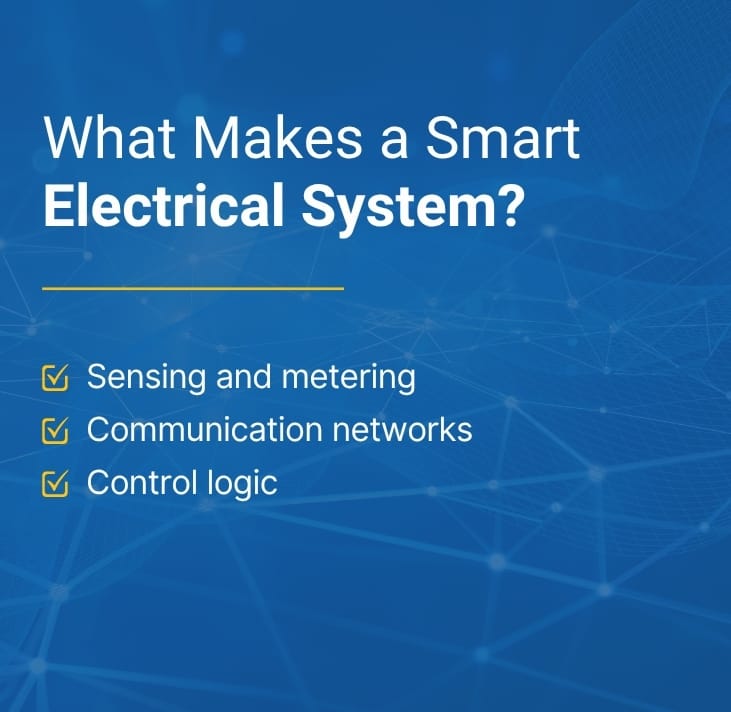
What Makes a Smart Electrical System?
1. Sensing and metering
Sensing and metering forms the first layer. Sub-meters at each distribution board measure voltage, current, power factor, and frequency. Temperature sensors on cable trays detect overheating. Vibration sensors on transformers identify loose windings. These devices sample data every second.2. Communication networks
Communication networks form the second layer. The system uses wired protocols like Modbus TCP or wireless standards like LoRaWAN. Data travels to a central gateway. No single point of failure exists. If one communication path breaks, the system reroutes through another.3. Control logic
Control logic forms the third layer. A local edge computer or cloud platform runs algorithms. It compares measured values against setpoints. It decides when to shed non-critical loads, when to charge batteries, and when to alert maintenance staff. Machine learning models improve decisions over time.Together, these layers create a system that understands its own state. It knows which circuits run, how much power each uses, and whether any anomaly exists. This awareness allows proactive management.Key Components of Smart UK Commercial Electrical Infrastructure
The table below lists essential hardware and software components. Commercial building owners should consider these items when planning a smart upgrade.| Component | Function | Typical Specification |
|---|---|---|
| Smart meter (class 1) | Measures whole-building import/export | Accuracy ±0.5%, 3-phase, 100A per phase |
| Sub-meters (class 2) | Monitors individual circuits | CT-clamp type, pulse output, 0.2% accuracy |
| Power quality analyser | Detects harmonics, sags, swells | EN50160 compliant, 31st harmonic |
| Programmable logic controller (PLC) | Executes control logic | IEC 61131-3, 8 analogue inputs |
| Solid-state relay | Switches loads without arcing | Zero-crossing type, 40A rating |
| Battery inverter | Manages energy storage discharge | Bi-directional, 97% efficiency |
| Building management system (BMS) | Provides user interface and reporting | BACnet or KNX compatible |
| IoT gateway | Aggregates sensor data | 4G/ethernet, MQTT protocol |
| Current transformers | Measures individual conductor current | Split-core, 333mV output |
Comparison: Traditional vs Smart UK Electrical System
| Feature | Traditional Electrical System | Smart Electrical System |
|---|---|---|
| Energy Monitoring | Manual | Real-time digital tracking |
| Efficiency | Moderate | High efficiency through automation |
| Maintenance | Reactive | Predictive maintenance |
| Control | Limited | Centralised smart control |
| Safety Systems | Basic protection | Advanced integrated safety |
| Scalability | Difficult | Easy and flexible |
Benefits for Building Owners and Occupants
Energy cost reduction provides the most direct benefit. A smart UK electrical system finds waste automatically. For example, the system notices that a meeting room’s lights stay on all night. It sends an alert. Or it detects that the air handling unit runs at full speed while windows are open. It then reduces the fan speed. Case studies from London offices show savings of 18% to 30% on electricity bills. Payback periods range from 18 to 36 months.
Improved reliability comes next. The system checks cable temperatures all the time. If a cable runs hotter than normal for its load, the system schedules an inspection before a fire can start. It also tracks circuit breaker trip history. Repeated trips mean a faulty appliance. Maintenance staff get exact location data. Mean time to repair falls by 40%.
Enhanced occupant comfort results from finer control. The system learns when people use each zone. It pre-heats areas before staff arrive. It dims lights on sunny afternoons. It balances three-phase loads to stop voltage dips. People notice fewer flickers and fewer temperature swings. Productivity studies show that stable environments boost output by 5%.
Regulatory compliance becomes simpler. The Energy Savings Opportunity Scheme (ESOS) requires energy audits. A smart system produces audit-ready reports on demand. The Minimum Energy Efficiency Standards (MEES) require an EPC rating of E or higher. Smart controls add points to the EPC calculation. Building owners avoid fines.
Challenges and Solutions
Implementing a smart electrical system presents hurdles. The table below lists common problems and practical solutions.
| Challenge | Description | Solution |
|---|---|---|
| Retrofit cost | Upfront hardware and installation expense | Use phased deployment; start with high-consumption circuits |
| Data overload | Too many alerts cause operator fatigue | Implement anomaly detection filters; alert only for 95th percentile events |
| Cybersecurity risk | Networked devices create attack surface | Segment electrical network from office IT; use VPNs and TLS encryption |
| Interoperability | Devices from different brands may not communicate | Specify open protocols (Modbus, BACnet) in contracts |
| Staff training | Existing technicians unfamiliar with smart features | Provide vendor-led workshops; maintain simple override switches |
| Power supply noise | Variable frequency drives cause interference | Use shielded cables and ferrite cores for sensor wiring |
A pragmatic approach solves most challenges. Begin with a pilot zone of 5–10 circuits. Measure baseline consumption for two weeks. Install smart sub-meters and a small PLC. Run the system for one month. Compare before and after data. The pilot proves the business case. Then expand to the whole building. This method reduces risk and spreads costs.
Regulatory Landscape and Future Trends
The UK government actively promotes smart electrical adoption. The Smart Systems and Flexibility Plan (2021) encourages demand-side response. Commercial buildings can sell flexibility to the grid. For example, a building with battery storage can discharge power during peak hours. The grid operator pays for this service. The 2023 Energy Act makes smart metering and load control mandatory for all new commercial buildings larger than 500 square metres.
European standards also affect UK practice. BS EN 50090 covers electronic systems in homes and buildings. BS EN 50491 defines general functions for smart metering. Installers must follow these standards. This protects warranty and insurance cover.
Looking ahead, three trends will shape the UK electrical system.
First, artificial intelligence will move from the cloud to local devices. A small microcontroller will run a lightweight neural network. It will predict next-hour electricity use with 99% accuracy.
Second, wireless power monitoring will replace most current transformers. Tiny sensors will harvest energy from the cables they monitor. They will clip onto wires and send data via Bluetooth. No batteries will be needed.
Third, grid-interactive buildings will become normal. A commercial building will respond automatically to wholesale electricity prices. It will charge its battery at 2 AM when prices are low. It will discharge at 4 PM when prices are high. The building owner earns a profit. No manual work is required.
Almens Consult: Turn Your Electrical System into an Asset
Transitioning to a smart UK electrical system requires careful planning. Almens Consult offers end-to-end support for commercial building owners. Their team conducts a free initial site walkthrough. They measure your existing panel schedules and load profiles. They then produce a detailed upgrade roadmap. This roadmap specifies which circuits need sub-meters, which loads can be automated, and what communication infrastructure fits your building layout. Almens Consult handles supplier negotiations. They source hardware from trusted brands like Schneider Electric, Siemens, and ABB at negotiated rates. Their certified electricians install all components without disrupting daily operations. After installation, they train your staff for three days. They also provide remote monitoring for the first six months. This service catches any configuration errors early. Many clients achieve payback within 24 months. Contact Almens Consult through their website for a no-obligation quote. Their advice alone often saves more than the consultation fee.
Your Next Step Toward a Smarter Electrical Future
A smart UK electrical system delivers measurable value to commercial buildings. It reduces energy waste by 20–30%. It improves reliability through predictive maintenance. It enhances occupant comfort with fine-grained control. The technology exists today. Open protocols and standard components keep costs manageable. Phased deployment lowers financial risk. Regulatory trends favour smart adoption, and grid-interactive features create new revenue streams. Building owners who delay upgrades will face higher operating costs and compliance penalties. Those who act now gain a competitive advantage. Start with an energy audit. Install sub-meters on your largest loads. Connect them to a basic BMS. Let data guide your next steps. The UK electrical system is evolving. Ensure your building leads the change.