




Most businesses only think about their electrical system when something goes wrong. A breaker trips during a busy shift. An energy bill arrives far higher than expected. An insurer asks for proof that the installation is safe. By then, the options are narrower and the costs are higher.
There is a better way to handle it. Bringing in expert advice early lets you plan power supply, protect your people, and cut waste before problems appear. That is the job of an independent adviser who studies your site and tells you plainly what it needs.
This guide explains what an electrical consultant does, how power design and energy management work in practice, and how to choose the right adviser for your business.
What an Electrical Consultant Actually Does
An electrical consultant gives technical advice on how electrical systems should be designed, assessed, and improved. Unlike a contractor, a consultant does not usually install the equipment. Their value comes from analysis and independent judgement.
A good consultant might check whether your site can carry a new production line. They might confirm that your protection devices will clear a fault safely. They might audit your energy use and show where money is being wasted. In each case, you get a clear answer backed by calculations rather than a sales pitch.
Typical services include:
- Power system design and load analysis
- Protection coordination studies
- Energy audits and efficiency planning
- Arc flash risk assessment
- Compliance reviews and inspection oversight
- Solar PV, battery storage, and EV charging integration
- Independent review of contractor designs and prices
Why Power Design Matters for Every Business
Power design is the foundation of a reliable site. It decides how electricity enters the building, how it is shared between circuits, and how faults are contained. Good design runs quietly for decades. Poor design causes trips, overheating, and expensive rebuilds.
Load Analysis Comes First
A load analysis lists every piece of equipment on site and works out how much power it needs, both in normal use and at peak. Many sites grow bit by bit without anyone checking the total. An electrical consultant often finds that parts of the network are running close to their limit.
Finding this early lets you plan an upgrade. Finding it after a failure means an emergency.
Protection Must Work Together
When a fault occurs, the device nearest to it should trip first. The rest of the site should keep running. A protection coordination study checks that this happens. Without it, one small fault can shut down a whole building.
Fault Levels Change Over Time
Adding solar panels, batteries, or a larger transformer raises the fault current at certain points. If a breaker is rated below that level, it may fail to clear a fault safely. A consultant checks these ratings before you commit to new equipment.
| Power Design Task | What It Prevents |
|---|---|
| Load analysis | Overloaded cables and supplies |
| Protection coordination | Wide outages from small faults |
| Fault level study | Under-rated switchgear |
| Earthing review | Shock risk and protection failure |
| Capacity planning | Surprises during expansion |
Energy Management: Where an Electrical Consultant Saves Money
Energy is one of the largest costs a business can control. Yet many sites have little idea where their power actually goes. An electrical consultant fixes that with an energy audit.
What an Energy Audit Reveals
The audit measures consumption across the site, often circuit by circuit. It then ranks the savings available, with a cost and payback period for each measure. Common findings include:
- Motors running at full speed when variable speed drives would cut use
- Older lighting that LED upgrades would reduce by more than half
- Poor power factor that adds avoidable charges
- Heating and cooling controls that ignore real occupancy
- Equipment left running outside working hours
| Energy Measure | Typical Saving | Typical Payback |
|---|---|---|
| Variable speed drives | 20 to 50% on motor energy | 1 to 3 years |
| LED lighting | 50 to 70% on lighting energy | 2 to 4 years |
| Power factor correction | 5 to 15% on electricity cost | 1 to 2 years |
| Sub-metering | 5 to 20% through better decisions | Under 1 year |
| Smart controls | 10 to 25% on controlled loads | 1 to 2 years |
Metering Turns Guesswork into Facts
Sub-metering shows which areas and machines use the most power. With that data, you can set targets, spot faults early, and prove that your improvements work.
Managing Peak Demand
Many bills include charges based on your highest demand. A consultant can design controls that stagger start-up of large loads or use battery storage at peak times. This lowers the charge without slowing production.
Staying on the Right Side of UK Law
Electrical safety is a legal duty, not a choice. A consultant helps you understand and meet it.
The Rules That Apply
The Electricity at Work Regulations 1989 require employers to keep electrical systems safe. BS 7671 sets the technical standard for installations. BS EN 50110 covers safe operation, including arc flash risk.
Inspection and Reporting
Industrial sites should have an Electrical Installation Condition Report every three years. Commercial sites usually need one every five years. Findings are coded C1, C2, C3, or FI, and C1 and C2 items need action.
Arc Flash Assessment
Arc flash is a violent release of energy from a fault in live equipment. It can cause severe injury and heavy damage. Many sites have never assessed this risk. A consultant calculates the energy at each point, specifies the protective clothing needed, and suggests ways to reduce the danger at source.
Solar, Batteries, and EV Charging
These technologies are now common on commercial sites. Each one affects your existing electrical system in ways that need proper study.
Solar PV needs a grid connection application and protection settings agreed with the network operator. Battery storage needs careful thermal and fire design. EV charging adds large new demand. A site with twenty vehicle chargers may need well over one hundred kilowatts of extra capacity.
An electrical consultant checks that your supply can cope, designs load management, and helps you avoid delays and redesign.
How to Choose the Right Electrical Consultant
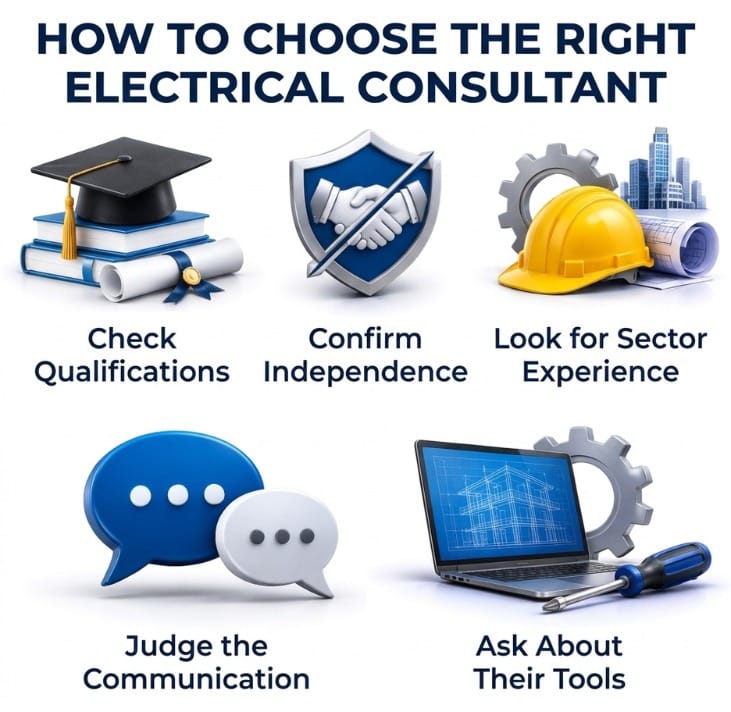
Check Qualifications
Look for Chartered Engineer status with the IET or Engineering Council. Ask who will do the work and what their experience is.
Confirm Independence
Ask whether the firm has financial ties to equipment suppliers or contractors. Independent advice is the whole point of hiring a consultant.
Look for Sector Experience
Healthcare, manufacturing, and data centres each have their own demands. Pick someone who knows your sector and ask for references.
Judge the Communication
A good consultant writes clearly and answers questions directly. How they communicate at the start is a good sign of how the project will go.
Ask About Their Tools
Serious studies use software such as ETAP, DIgSILENT PowerFactory, or SKM. Ask which tools the firm uses and how it checks results.
| Mistake | Better Approach |
|---|---|
| Choosing on fee alone | Compare skills, independence, and experience |
| Hiring too late | Bring in advice before buying equipment |
| Skipping references | Speak to a past client |
| Vague scope | Agree deliverables in writing |
| Not asking about ties | Ask about supplier relationships |
Almens Consult: Independent Advice You Can Act On
Almens Consult helps UK businesses make sound decisions about power design and energy use. The team carries out power system studies, energy audits, arc flash assessments, and compliance reviews. It also advises on solar PV, battery storage, and EV charging, and reviews contractor proposals before you commit.
Because Almens Consult has no ties to suppliers or installers, every recommendation reflects what your site truly needs. If you want clear, honest advice you can use with confidence, it is a strong place to start.
Plan Early and Let Good Advice Pay for Itself
A reliable electrical system does not happen by accident. It comes from sound design, regular checks, and steady attention to energy use. Electrical engineering consultants bring the skill and independence needed to do that properly.
Start with the question that worries you most, whether that is capacity, compliance, or cost. Then choose an adviser who is qualified, independent, and clear in their communication. The time you spend now is small next to the cost of fixing problems later, and the savings tend to keep coming for years.
FAQs
1. What does an electrical consultant do?
An electrical consultant advises on the design, safety, efficiency, and compliance of electrical systems. Services include power studies, energy audits, and arc flash assessments.
2. How is a consultant different from an electrical contractor?
A contractor installs and maintains equipment. A consultant analyses and advises without installing, which keeps the advice independent.
3. How much does an electrical consultant cost in the UK?
Day rates usually range from £500 to £1,500 or more, depending on experience and specialism. Many audits and studies are priced as fixed fees.
4. When should I hire an electrical consultant?
Hire one before an expansion, before reviewing a contractor quote, when planning solar or EV charging, or when you face a compliance question.
5. Can an electrical consultant really lower my energy bills?
Yes. An energy audit finds waste in motors, lighting, controls, and power factor. Many measures pay back within one to three years.