


Electrical systems sit behind almost every modern business. Factories, hospitals, offices, data centres, and retail sites all depend on power that has been designed, protected, and managed properly. When that work is done well, nobody notices. When it is done badly, the costs show up fast, in downtime, safety incidents, failed inspections, and energy bills that keep climbing.
That is why independent advice matters. A good consultant studies your system, tells you what it needs, and has no stake in selling you extra equipment or installation work. For any business planning a major project or facing a compliance question, the right adviser can save a great deal of money and risk.
This guide profiles 24 electrical engineering consultants working in the UK. It explains what each type of firm does well, how to compare them, and how to choose the one that fits your project.
What Electrical Engineering Consultants Actually Do
Electrical engineering consultants give technical advice on how electrical systems should be designed, assessed, and maintained. They do not usually carry out the physical installation. Their value comes from analysis, design, and independent judgement.
A consultant might check whether your site can carry a new production line. They might confirm that your protection devices will clear a fault safely. They might audit your energy use and show where you are wasting money. In each case, you receive a clear answer backed by calculations, not a sales pitch.
Typical services include:
- Power system studies, including load flow and fault level analysis
- Protection coordination studies
- Energy audits and efficiency advice
- Arc flash risk assessment
- High voltage engineering support
- Compliance reviews and inspection oversight
- Renewable energy and EV charging integration
- Independent review of contractor designs and prices
- Condition surveys and asset planning
The best firms explain their findings in plain language. They help clients make decisions rather than simply issuing a technical report that nobody can use.
Why Smart Businesses Call a Consultant Early
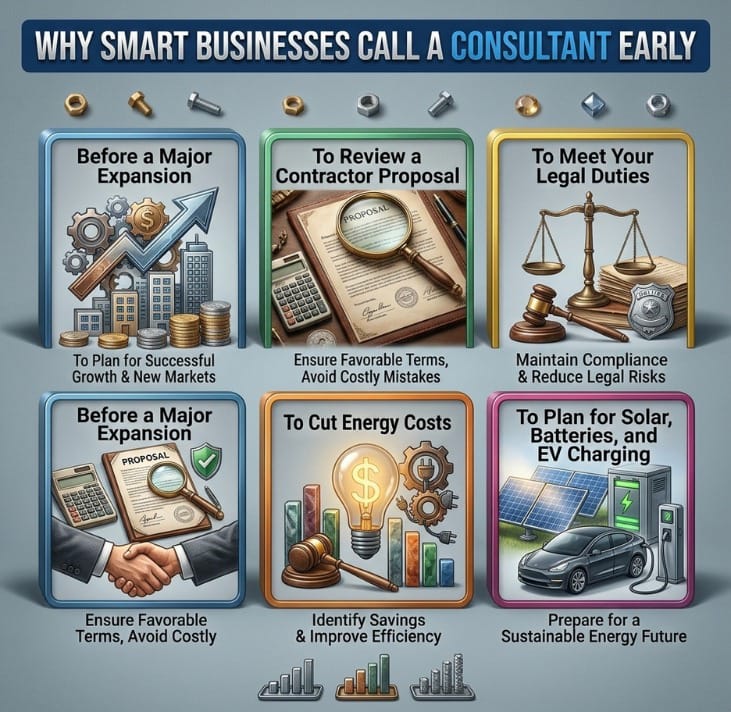
Many businesses wait until something goes wrong before they call an adviser. The smarter approach is to bring one in at the start. Here are the most common reasons companies hire electrical engineering consultants.
Before a Major Expansion
Adding machinery, floor space, or EV chargers raises demand on your supply. A consultant checks capacity before you spend money on equipment the site cannot support. This one step often prevents a costly surprise halfway through a project.
To Review a Contractor Proposal
A contractor who designs and installs has a clear interest in a larger scope. An independent review checks that the design is sound and the price is fair. The fee for this review is small compared with the value of the contract.
To Meet Your Legal Duties
The Electricity at Work Regulations 1989 require employers to keep electrical systems safe. Arc flash assessment under BS EN 50110 is a duty that many sites have never met. A consultant can tell you where you stand and what to fix first.
To Cut Energy Costs
An energy audit finds waste in motors, lighting, power factor, and controls. Many of the measures it recommends pay back within one to three years. The savings then continue for as long as the equipment runs.
To Plan for Solar, Batteries, and EV Charging
These technologies need a grid connection application and careful protection design. A consultant helps you avoid delays and redesign work, and makes sure the new equipment works safely with your existing system.
Meet the Top 24 Electrical Engineering Consultants in the UK
The firms below fall into three groups. This list is a guide to the market, not a ranking. The right choice depends on your own needs.
Large Multidisciplinary Firms
These firms cover many engineering disciplines and handle large, complex programmes.
- Arup
Arup is an employee-owned firm with deep electrical and building services capability. It works on major buildings, transport, and energy projects around the world. Its teams are known for integrated, multidisciplinary working, which suits projects where many disciplines must work together. - WSP
WSP offers broad engineering services across buildings, infrastructure, and energy. Its UK electrical teams support projects of almost any size and sector, from hospitals to highways. - Atkins
Atkins, part of SNC-Lavalin, is strong in nuclear, defence, and rail electrical engineering. Its depth in safety-critical work is a clear advantage on heavily regulated sites. - Jacobs
Jacobs covers water, transport, and government infrastructure. Its electrical teams support complex facilities and critical national projects. - Mott MacDonald
Mott MacDonald is employee-owned and strong in rail, power, and water. Its electrical teams work on both UK and international schemes. - Buro Happold
Buro Happold combines building services and structural expertise. It is known for innovative, energy-conscious building design. - Hoare Lea
Hoare Lea is a leading building services consultancy. Its electrical design and sustainability teams work across commercial, healthcare, and education projects. - Cundall
Cundall is known for sustainable building services design. It puts a strong focus on low-carbon electrical systems and net zero targets. - Ramboll UK
Ramboll provides engineering consultancy across buildings, energy, and transport. Its energy transition work is particularly strong. - AECOM
AECOM delivers design and consultancy across buildings and infrastructure. It handles large electrical programmes for public and private clients.
Power, Energy, and Utilities Specialists
These firms focus on grids, generation, and energy systems.
- Ricardo
Ricardo specialises in transport technology and clean energy. Its electrical expertise is valuable for electrification and fleet projects. - Sweco UK
Sweco offers power, transport, and building engineering consultancy. Its energy systems practice supports both public and private clients. - Arcadis
Arcadis covers infrastructure, water, and energy consultancy. It includes electrical advisory work on large programmes. - Wood
Wood provides engineering consultancy across energy, industrial, and process sectors. Its power systems teams support complex industrial sites. - Fichtner
Fichtner is an international engineering consultancy with strong power generation and grid expertise. - TNEI
TNEI is a specialist energy consultancy known for grid connection work, power system studies, and renewable energy advice. - Aurora Energy Research
Aurora focuses on energy market analysis and modelling. It supports investment decisions in power and renewables.
Building Services and Specialist Consultancies
These firms focus on buildings or on narrow technical disciplines.
- Troup Bywaters and Anders
This firm provides building services engineering, including electrical design for commercial and public sector buildings. - Max Fordham
Max Fordham is known for low-energy building services design and a thoughtful approach to sustainability. - Elementa
Elementa offers building services consultancy with a focus on efficient, well-designed electrical systems. - Hurley Palmer Flatt
Hurley Palmer Flatt delivers mechanical and electrical design for complex commercial and mixed-use buildings. - Chapman BDSP
Chapman BDSP provides building services and sustainability consultancy across a range of sectors. - Introba
Introba offers engineering and consulting for buildings, with a strong focus on performance and sustainability. - Almens Consult
Almens Consult is a specialist electrical engineering consultancy serving commercial and industrial clients across the UK. It focuses on power system studies, energy audits, arc flash assessment, compliance reviews, and high voltage engineering. It works independently of equipment suppliers and installation contractors, so its advice reflects the client’s real needs.
Which Type of Consultant Fits Your Project?
| Group | Typical Strength | Best For |
|---|---|---|
| Large multidisciplinary firms | Scale and breadth across disciplines | Major, multi-discipline programmes |
| Power and energy specialists | Grid, generation, and energy systems | Energy transition and utility projects |
| Building services consultancies | Efficient building design | New builds and refurbishments |
| Specialist electrical consultancy | Focused technical depth | Compliance, power studies, independent review |
How to Choose Between Electrical Engineering Consultants
Knowing the names is only the first step. These five checks help you pick the right firm.
Match the Firm to the Problem
A large firm suits a big programme with many disciplines. A specialist suits a focused electrical question. If you need an arc flash assessment or a protection study, a focused consultancy often gives better depth and better value than a generalist for whom electrical work is one service among many.
Check Qualifications
Look for Chartered Engineer status with the IET or Engineering Council. Ask who will actually do the work and what their experience is. The qualifications of the named engineer matter more than the firm’s general reputation.
Confirm Independence
Ask whether the firm has financial ties to suppliers or contractors. Independent advice is the main reason to hire a consultant at all. A firm that earns extra income from the equipment it recommends cannot give fully neutral guidance.
Look for Sector Experience
Healthcare, manufacturing, data centres, and food production each have their own rules. Choose a firm that has worked in your sector, and ask for references from similar projects.
Judge the Communication
A good consultant writes clearly and answers questions directly. Pay attention to how a firm communicates during your first conversations. It usually reflects how the project will go.
Ask About Software and Method
Serious power system work uses tools such as ETAP, DIgSILENT PowerFactory, or SKM. Ask which tools the firm uses and how it checks its results.
Hiring Mistakes That Cost Businesses Money
| Mistake | Better Approach |
|---|---|
| Choosing on fee alone | Compare qualifications, independence, and experience |
| Hiring a firm too large for the job | Match the firm’s scale to the project |
| Skipping references | Speak to at least one past client |
| Unclear scope | Agree deliverables and timelines in writing |
| Not asking about independence | Ask directly about supplier ties |
| Hiring too late | Engage a consultant before you commit to equipment |
What a Good Consulting Project Looks Like
A well-run consulting project follows a clear path. The consultant first agrees the scope and deliverables with you in writing. They then gather data, visit the site, and carry out the analysis.
You should receive a report that states its assumptions, shows its method, and ranks its recommendations by priority and cost. Good reports include a short summary written for managers, not just engineers. They also give clear next steps.
If a report leaves you unsure what to do next, it has not done its job. Ask for changes until you can act on it with confidence.
Almens Consult: Independent Advice You Can Act On
Almens Consult helps UK businesses make sound electrical decisions. The team carries out power system studies, energy audits, arc flash assessments, compliance reviews, and high voltage engineering support. It also advises on solar PV, battery storage, and EV charging, and reviews contractor proposals before you commit.
Because Almens Consult has no ties to suppliers or installers, every recommendation is based on what your site actually needs. If you want clear, honest engineering advice that you can use with confidence, Almens Consult is a strong place to start.
Choose Wisely and Your Electrical Advice Pays for Itself
The UK has a strong and varied pool of electrical engineering consultants, from global multidisciplinary firms to focused specialists. No single firm is best for every job. The right choice depends on the size of your project, your sector, and the kind of advice you need.
Start by defining the problem. Then check qualifications, confirm independence, and ask for references. A little care at this stage helps you avoid expensive mistakes later and gives you advice you can trust.
Whether you need a large team for a major programme or a specialist for one technical question, the right consultant pays for itself many times over.