




Industrial facilities run on electricity. Every production line, every automated system, every piece of critical equipment depends on an electrical infrastructure that must be reliable, safe, and capable of meeting demands that are growing every year. For plant managers, operations directors, and facilities engineers, the electrical infrastructure is not background detail. It is one of the most operationally significant assets the business owns.
The challenge is that industrial electrical infrastructure is also one of the most expensive to maintain and most consequential to get wrong. An unplanned outage on a production line costs money by the hour. A protection system that fails to operate correctly during a fault can damage equipment worth hundreds of thousands of pounds. A compliance failure identified by a regulator during an inspection carries its own costs in penalties, remediation, and reputational damage.
Getting the electrical engineering solutions right in an industrial setting is therefore not just a technical exercise. It is a business decision that affects productivity, safety, cost, and the organisation’s ability to grow.
What Industrial Electrical Engineering Solutions Cover
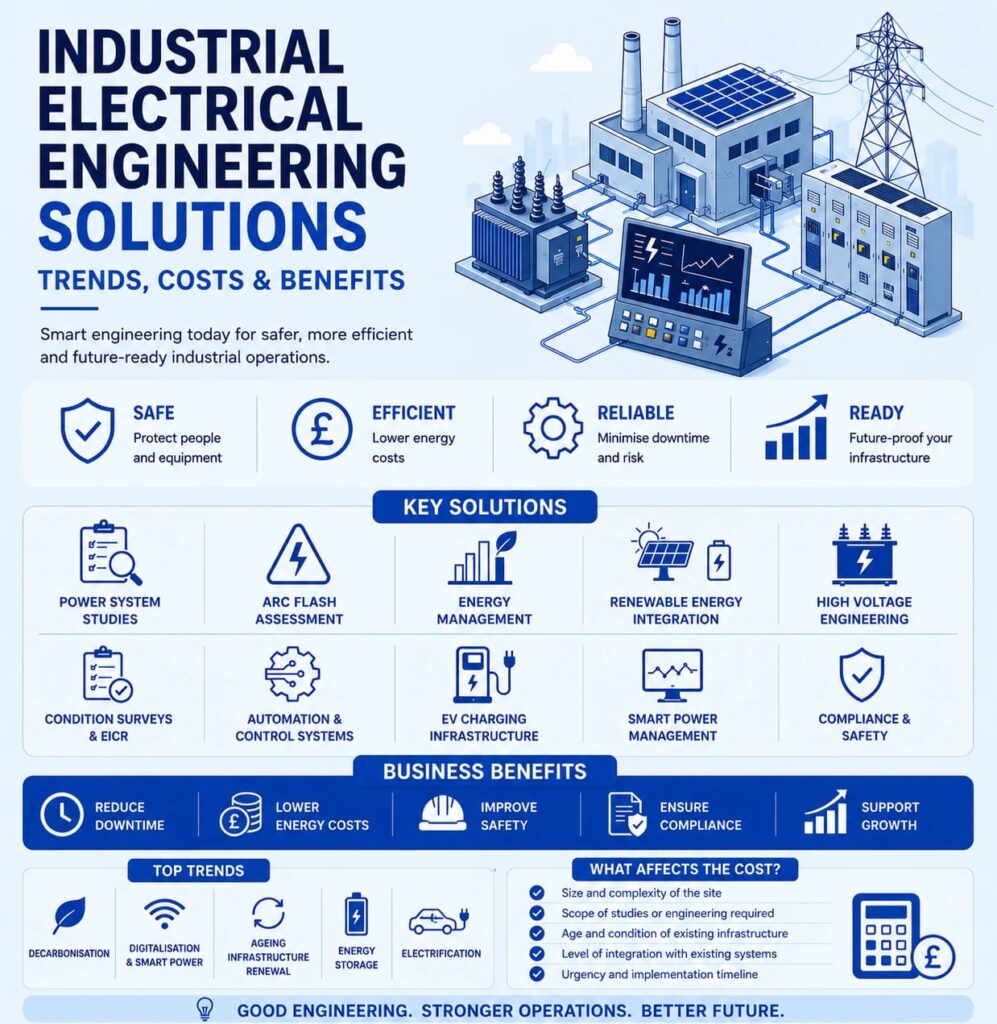
Electrical engineering solutions in an industrial context cover a much broader scope than the installation and maintenance of cables and switchgear. They encompass the full lifecycle of electrical infrastructure planning, from the initial design of a new facility through to the ongoing management of an ageing system and the engineering decisions about when to upgrade.
A complete set of industrial electrical engineering solutions typically includes:
- Power system design and load analysis to ensure the distribution network is sized correctly for current and future demand
- Protection system design and coordination studies to verify that fault protection operates correctly across the whole site
- Energy management and efficiency studies to identify where energy is being wasted and how consumption can be reduced
- Arc flash risk assessment to protect maintenance staff working near live electrical equipment
- High-voltage engineering for sites with HV supplies or on-site HV distribution
- Condition surveys and EICR to assess the current state of the installation and prioritise remedial work
- Renewable energy integration including solar PV, battery storage, and EV charging infrastructure
- Automation and control system design for sites integrating process control with the electrical infrastructure
Each of these areas addresses a specific operational risk or improvement opportunity. Together they represent the full scope of professional electrical engineering input that a well-managed industrial facility requires.
Current Trends Shaping Industrial Electrical Engineering Solutions
Decarbonisation and the Shift to Low-Carbon Electrical Infrastructure
The most significant trend shaping industrial electrical engineering solutions in the UK is decarbonisation. Government targets, corporate net zero commitments, and the rising cost of carbon-intensive energy have put pressure on industrial operators to reduce their electrical carbon footprint while maintaining or improving operational capability.
In practice this means several things for electrical engineering:
On-site generation through solar PV Large industrial rooftops and land parcels are increasingly being used for solar PV installations that offset grid electricity consumption. Engineering challenges include grid connection under Engineering Recommendation G99, protection relay settings, export limiting, and integration with the site’s existing distribution network without compromising its safety or compliance status.
Battery energy storage systems Battery storage allows industrial sites to shift energy consumption away from peak tariff periods, store excess solar generation, and provide backup power for critical processes. Engineering requirements include sizing the system correctly for the load profile, specifying thermal management appropriate for a lithium-ion installation, and integrating with both the grid connection and the on-site generation.
Electric vehicle fleet charging Industrial operators with vehicle fleets are under increasing pressure to electrify. A site with twenty commercial vehicles transitioning to electric needs to add significant electrical capacity for overnight charging. Without a load management strategy designed by a qualified engineer, the existing HV or LV supply will not handle the demand.
Smart Power Management and Digitalisation
Industrial electrical engineering solutions increasingly incorporate smart monitoring and management technology that gives operations teams real-time visibility into power consumption, power quality, and system performance.
Sub-metering at the circuit level allows energy managers to see exactly where electricity is being consumed and to identify anomalies that indicate equipment faults or inefficiency. Power quality monitoring detects harmonic distortion, voltage fluctuations, and power factor problems that affect sensitive equipment and increase energy costs. SCADA integration connects the electrical system to the facility’s wider operational technology environment.
These capabilities are not new, but the cost and accessibility of the technology has reduced significantly. Industrial facilities that have not yet invested in smart power monitoring are paying for energy they do not fully understand and missing early warning signals for equipment that is about to fail.
Ageing Infrastructure and the Investment Case for Renewal
A significant proportion of industrial electrical infrastructure in the UK was installed in the 1970s, 1980s, and 1990s and has reached or exceeded its design life. Switchgear that is thirty years old carries increasing risk of failure, limited spare parts availability, and growing challenges in meeting current protection requirements.
The trend of infrastructure renewal is accelerating as these assets age and as the cost of an unplanned failure becomes more clearly understood. A condition survey that identifies specific assets approaching end of life allows the business to plan and budget a renewal programme. That is a very different position from an unplanned failure that requires emergency procurement, extended downtime, and reactive expenditure at premium cost.
Key Electrical Engineering Solutions for Industrial Facilities
Power System Studies
Power system studies are the engineering analysis that underpins safe and reliable industrial electrical infrastructure. They include:
Load flow analysis Examines how electrical current distributes across the network under normal and abnormal conditions. Identifies voltage drop problems, overloaded cables and transformers, and sections of the system operating close to their rated capacity. Essential before adding significant new loads to an existing network.
Short-circuit analysis Calculates the fault current available at every point in the distribution network. This determines whether protective devices are rated to interrupt faults safely and whether switchgear meets the required breaking capacity. On older industrial sites with no recent study, the available fault level may have changed significantly since the original design.
Protection coordination study Verifies that protection devices at different levels of the system discriminate correctly. When a fault occurs, only the device closest to the fault should operate. If discrimination is not correctly set, a fault on a small circuit can cause a large section of the site to lose power.
Harmonic analysis Variable speed drives, UPS systems, and other non-linear loads generate harmonic currents that distort the voltage waveform and cause problems for sensitive equipment, overheating in cables and transformers, and interference with protection systems. A harmonic study identifies the source and magnitude of harmonic distortion and specifies the filtering required to control it.
| Power System Study | What It Identifies | Operational Risk if Omitted |
|---|---|---|
| Load Flow Analysis | Overloaded cables, voltage drop problems | Equipment damage, regulatory non-compliance |
| Short-Circuit Analysis | Inadequate breaking capacity in switchgear | Catastrophic switchgear failure during fault |
| Protection Coordination | Incorrect discrimination between devices | Unnecessary widespread loss of supply during fault |
| Harmonic Analysis | Distortion from non-linear loads | Equipment failure, overheating, interference |
| Arc Flash Assessment | Incident energy at each switchboard | Serious injury to maintenance staff |
| Load Growth Study | Future capacity headroom | Constraints on operational expansion |
Arc Flash Risk Assessment in Industrial Environments
Arc flash is one of the most serious hazards in industrial electrical environments and one of the most frequently overlooked. When a fault develops in live switchgear or distribution equipment, the energy released can cause severe burns, blast injuries, and deaths. Industrial sites with high fault current availability are particularly at risk.
Under the Electricity at Work Regulations 1989 and BS EN 50110, employers have a duty to assess and manage arc flash risk for any work on or near live electrical equipment. The assessment process involves:
- Calculating the incident energy available at each point in the distribution system using specialist software
- Determining the arc flash boundary, the distance within which unprotected individuals face risk of injury
- Specifying the correct PPE category for any live work that cannot be avoided
- Identifying system changes, such as protection setting adjustments, that can reduce incident energy at the source
For many industrial sites, the arc flash assessment reveals risks that were not previously understood and recommends both engineering controls and procedural changes that significantly reduce the risk to maintenance staff.
High Voltage Engineering Solutions
Industrial sites that operate at high voltage, whether through a direct HV supply from the grid or through on-site HV distribution between buildings or processes, require electrical engineering solutions that go beyond what is needed for LV-only sites.
HV engineering requirements for industrial facilities include:
- Substation design and specification for sites with their own HV/LV transformers
- HV protection relay settings verified against the Distribution Network Operator’s requirements
- Written safety rules and safe systems of work for HV operations
- Authorised person schemes designating competent individuals for HV switching
- HV condition surveys assessing the state of ageing HV switchgear and cables
The Electricity at Work Regulations impose specific requirements on HV operations that go beyond those applicable to LV systems. Engineering solutions for HV industrial environments must address both the technical requirements and the operational safety management framework.
Energy Management and Efficiency Engineering
Energy is one of the largest controllable costs in most industrial operations. Electrical engineering solutions that address energy efficiency deliver returns that are visible in the monthly energy bill and compound over the contract period.
Key energy efficiency interventions for industrial facilities:
Variable speed drives on motors Industrial motors driving pumps, fans, conveyors, and compressors at fixed speed consume energy regardless of the actual process demand. Variable speed drives match motor speed to demand, typically reducing motor energy consumption by twenty to fifty percent. The payback period for a well-specified VSD installation is usually one to three years.
Power factor correction Industrial loads including motors, transformers, and welding equipment draw reactive power that does not perform useful work but does increase the current flowing through the network. Utilities charge for poor power factor through maximum demand charges or reactive power tariffs. Power factor correction equipment installed at the right points in the network reduces these charges and may also allow existing cable and switchgear to carry additional loads.
Sub-metering and energy monitoring Installing metering at the circuit level gives operations teams the visibility needed to identify where energy is being consumed and where waste is occurring. Baseline measurement before and after efficiency interventions confirms the savings achieved and identifies further opportunities.
Lighting upgrades Industrial lighting systems in older facilities often still use high-pressure sodium or metal halide technology. LED replacement delivers fifty to seventy percent energy saving on lighting loads, improved lumen output, and significantly longer lamp life that reduces maintenance costs.
| Energy Efficiency Measure | Typical Saving | Payback Period |
|---|---|---|
| Variable Speed Drives on Motors | 20 to 50% on motor energy | 1 to 3 years |
| Power Factor Correction | 5 to 15% on electricity costs | 1 to 2 years |
| LED Lighting Replacement | 50 to 70% on lighting energy | 2 to 4 years |
| Sub-Metering and Monitoring | 5 to 20% through behavioural change | Under 1 year |
| Compressed Air System Optimisation | 20 to 40% on compressor energy | 1 to 3 years |
| HVAC Controls and BMS Integration | 15 to 30% on HVAC energy | 2 to 5 years |
Understanding the Costs of Industrial Electrical Engineering Solutions
One of the most common barriers to investing in proper electrical engineering solutions for industrial facilities is uncertainty about cost. The reality is that costs vary significantly depending on the scope, the size of the facility, and the complexity of the electrical system. Understanding the typical cost structure helps operations and finance teams plan and budget appropriately.
Power System Studies
Indicative costs for power system studies at industrial facilities:
- Load flow analysis: £3,000 to £15,000 depending on system size and complexity
- Protection coordination study: £4,000 to £20,000
- Harmonic analysis: £3,000 to £10,000
- Arc flash assessment: £5,000 to £25,000 for a multi-board industrial site
- Combined power system studies package: £10,000 to £40,000
These are engineering fees for the study work. Implementation costs for any remedial work identified are additional and depend on the scope of changes required.
Energy Management Studies and Implementation
An energy audit and management study for an industrial facility typically costs between £5,000 and £25,000 depending on site size and the depth of analysis required. The cost of implementing the recommended measures varies widely:
- VSD installation per motor: £2,000 to £20,000 depending on motor rating
- Power factor correction system: £5,000 to £50,000 depending on site demand profile
- Sub-metering installation: £500 to £3,000 per metering point
- LED lighting upgrade: £10 to £40 per fitting replaced, including installation
The return on these investments, in energy cost reduction, is typically faster than finance teams expect when they see the initial outlay.
Infrastructure Condition Survey and Remediation
A condition survey of the electrical infrastructure at a medium to large industrial facility typically costs between £5,000 and £20,000. The survey identifies prioritised remedial work across the installation, allowing the business to plan a multi-year investment programme rather than facing an unplanned capital requirement when equipment fails unexpectedly.
The Business Case for Investing in Electrical Engineering Solutions
The benefits of investing in proper industrial electrical engineering solutions span several dimensions that individually justify the investment and collectively make it straightforward to approve.
Reduced downtime risk Planned electrical engineering work, including condition surveys, protection studies, and infrastructure renewal, reduces the probability of unplanned outages. The cost of an hour of unplanned downtime on a production line often exceeds the cost of the engineering work that would have prevented it.
Lower energy costs Energy efficiency engineering solutions deliver returns that are direct, measurable, and recurring. Unlike one-time capital investments, the energy saving continues for the life of the equipment.
Regulatory compliance Industrial facilities operating without current EICR documentation, without arc flash assessments, or without proper HV safety management are exposed to prosecution under the Electricity at Work Regulations. The cost of compliance is a fraction of the cost of a regulatory investigation or prosecution.
Safer working environment Electrical engineering solutions that address arc flash risk, protection system reliability, and earthing and bonding deficiencies directly reduce the risk of serious injury to maintenance staff. The human cost of an electrical incident is immeasurable. The financial and reputational cost for the business is substantial.
Infrastructure readiness for growth A capacity study and load growth analysis identifies whether the existing electrical infrastructure can support the business’s expansion plans. Getting this engineering done before committing to a capital investment in new production equipment or a new building prevents the expensive discovery that the supply cannot meet the additional demand.
How Almens Consult Can Help Your Industrial Facility
Almens Consult delivers electrical engineering solutions for industrial facilities across the full range of engineering disciplines. The team provides power system studies including load flow, protection coordination, harmonic analysis, and arc flash assessment. It delivers energy management reviews that identify and quantify savings opportunities, supports renewable energy integration including solar PV and battery storage, and provides HV engineering expertise for sites with high voltage infrastructure. Almens Consult also carries out condition surveys and EICR inspections that give industrial operators a clear, prioritised picture of the state of their electrical infrastructure and the investment required to bring it up to standard. Whether the need is immediate, driven by a compliance requirement or an operational problem, or planned as part of a longer-term infrastructure strategy, Almens Consult provides the technical rigour and the practical perspective that industrial electrical engineering demands.
Good Electrical Engineering Is the Foundation of Industrial Reliability
Industrial operations that invest in proper electrical engineering solutions consistently outperform those that treat electrical infrastructure as a maintenance cost to be minimised. The difference shows in downtime rates, energy costs, safety records, and the speed with which the business can respond to growth opportunities.
The trends shaping industrial electrical engineering solutions in 2026, decarbonisation, smart power management, and ageing infrastructure renewal, all point in the same direction. The businesses that address them proactively, with qualified engineers and a structured approach to their electrical infrastructure, are the ones that will operate most reliably and most cost-effectively in the years ahead.
The investment in electrical engineering solutions is not a discretionary improvement. It is the foundation of operational reliability, regulatory compliance, and the capacity to grow.
FAQs
What do industrial electrical engineering solutions cover?
Everything from power system design and protection studies to energy efficiency, arc flash assessment, HV engineering, and condition surveys. Basically all the technical work that keeps an industrial electrical system safe, legal, and running properly.
How often does an industrial site need an EICR?
Every three years as a general rule. Sites with older installations or higher-risk activities may need it more frequently. The inspecting engineer will advise based on what they find on site.
What is arc flash and why does it matter?
It is a violent release of electrical energy from a fault in live switchgear. It can cause fatal injuries. The Electricity at Work Regulations require it to be formally assessed and managed. Many industrial sites are not doing this and do not realise they are legally exposed.
How much can variable speed drives save?
Typically twenty to fifty percent on motor energy for pumps, fans, and compressors. Payback is usually one to three years and the saving continues for the life of the equipment.
When does a site need a protection coordination study?
When significant new loads have been added, when fault levels may have changed, or when unplanned outages suggest protection is not operating as it should. Many older sites have never had one done.
Does my site need HV engineering if it has its own transformers?
Yes. Sites with HV supplies or their own transformers have specific legal obligations that require HV-competent engineers. This cannot be handled by LV-qualified contractors.
How do solar PV and battery storage affect existing infrastructure?
Both require engineering management to integrate safely. Solar PV needs a grid connection agreement under G99. Battery storage needs thermal management and careful system integration. Neither should be installed without proper engineering input.
How do I make the business case for electrical engineering investment?
Work out what an hour of unplanned downtime costs the business. Compare that with the cost of the engineering study that would have prevented it. Add recurring energy savings and reduced regulatory risk. The numbers usually make the case on their own.