




Ask most business owners which electrical certificates their building actually needs and you will get a blank look. That is not a criticism. Nobody teaches this in business school, and unless something has already gone wrong, electrical paperwork tends to sit at the bottom of the priority list, somewhere below payroll and slightly above updating the website.
The problem is that electrical certificates are not optional admin. They are the documents that prove your electrical system is safe, that protect you legally if something does go wrong, and that insurers and landlords will ask for without warning. Get caught without the right one and you are looking at fines, invalidated insurance, or a building that cannot legally be occupied.
This guide walks through the five certificates that matter most for UK businesses, what each one actually covers, and where professional electrical engineering services fit into getting them right.
Why Electrical Certificates Matter More Than You Think
Electrical engineering services exist precisely because certificates are not just bits of paper. Each one is the output of an inspection or test carried out by a qualified person, and each one represents a legal or contractual obligation that businesses cannot simply ignore.
Skip the right certificate and the consequences stack up quickly:
- Insurance claims can be refused if the installation was not certified to the relevant standard
- Landlords can be held liable under the Landlord and Tenant Act if they fail to maintain a safe electrical installation
- The Health and Safety Executive can prosecute under the Electricity at Work Regulations 1989
- Tenants and employees can bring civil claims if they are injured by faulty electrical equipment
None of these outcomes are hypothetical. They happen to real businesses every year, usually because nobody thought to check what certificate was actually required.
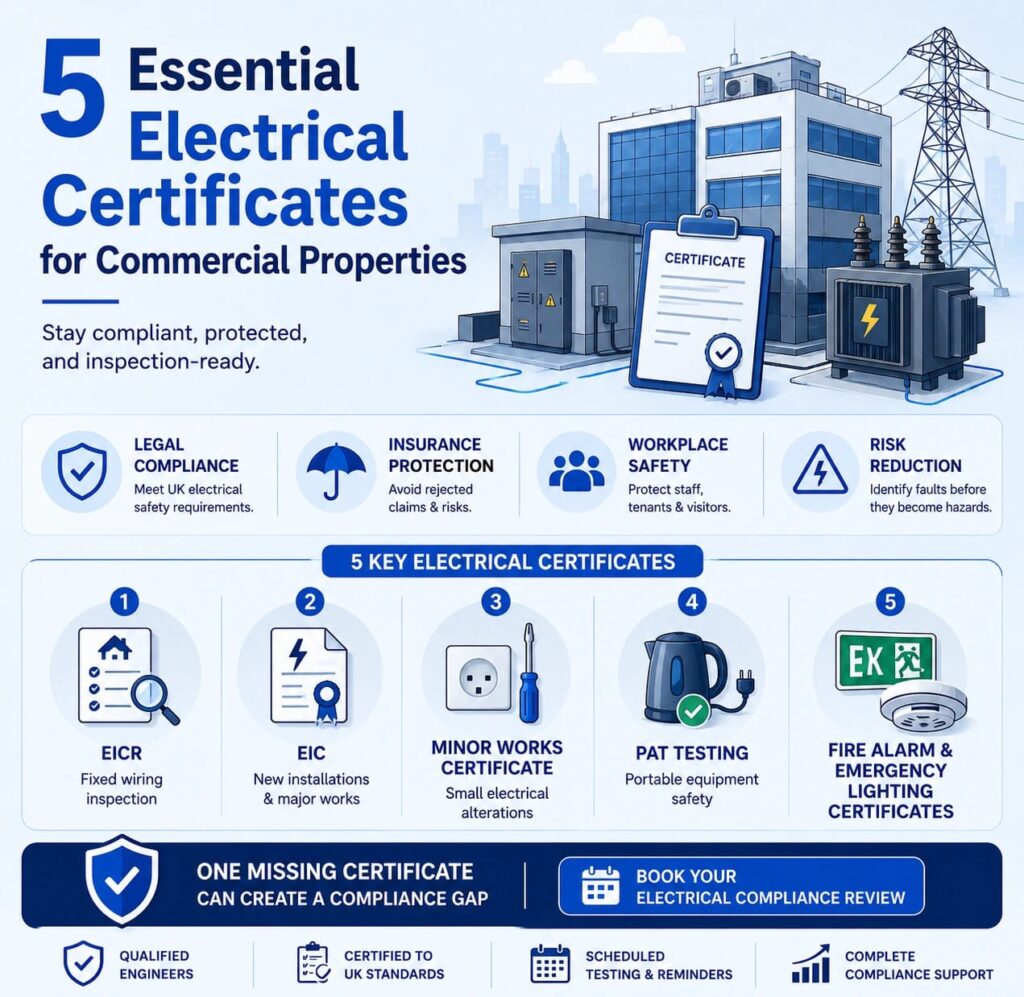
1. Electrical Installation Condition Report (EICR)
The EICR is the certificate most people think of first, and for good reason. It is the document that confirms the overall condition of a building’s fixed electrical installation, covering everything from the consumer unit to the sockets on the wall.An EICR involves a qualified electrician inspecting and testing the wiring, checking earthing and bonding, examining the condition of switches and sockets, and assessing whether the installation meets the current edition of BS 7671, the IET Wiring Regulations.The report classifies any issues found using a simple code:| Code | Meaning | Action Required |
|---|---|---|
| C1 | Danger present | Immediate remedial action |
| C2 | Potentially dangerous | Urgent remedial action |
| C3 | Improvement recommended | No legal requirement to act, but advisable |
| FI | Further investigation needed | Required before classification can be confirmed |
2. Minor Electrical Installation Works Certificate (MEIWC)
Not every piece of electrical work needs a full EICR. When the job is small, replacing a socket, adding a light fitting, or extending a circuit without a new consumer unit, the relevant certificate is a Minor Electrical Installation Works Certificate.This certificate confirms that the specific piece of work carried out meets BS 7671, without certifying the condition of the entire installation. It is signed by the electrician who did the work and should be kept by the property owner as proof that the addition or alteration was completed safely.The distinction matters because using the wrong certificate creates a paperwork gap. A business that has had several minor works certificates issued over the years but no EICR may have no documented evidence of the overall condition of its electrical system, even though individual jobs were certified correctly at the time.3. Electrical Installation Certificate (EIC)
When new electrical work is installed, whether that is a new circuit, a full rewire, or the electrical fit-out of a new commercial unit, the certificate required is the Electrical Installation Certificate.The EIC is more detailed than the minor works version. It requires the electrician to record design, construction, and inspection and testing information, and it must be signed off by someone competent in each of those three areas. For larger projects, this often means three different qualified people, or one engineer signing off on all three if they hold the relevant competence.This certificate is particularly important for new commercial fit-outs, because it forms part of the documentation a business needs to demonstrate compliance with the Building Regulations. Building control bodies will often ask to see the EIC before signing off a project, and insurers will expect to see it if a claim relates to a recently completed installation.4. Portable Appliance Testing (PAT) Certificate
PAT testing covers a different category entirely. Rather than the fixed wiring of a building, it addresses the portable electrical equipment plugged into it, kettles, computers, extension leads, power tools, and anything else with a plug.There is no specific legal requirement in the UK that mandates PAT testing by name. What does exist is a clear legal duty under the Electricity at Work Regulations 1989 and the Provision and Use of Work Equipment Regulations 1998 to ensure electrical equipment is maintained in a safe condition. PAT testing is the recognised, practical way most businesses demonstrate they are meeting that duty.A PAT certificate confirms which items were tested, the date of testing, the result, and the recommended date for the next test. Testing frequency depends on the type of equipment and the environment it is used in:| Equipment Type | Typical Testing Interval |
|---|---|
| Office IT equipment | Every 4 years (visual checks more frequently) |
| Portable tools on construction sites | Every 3 months |
| Equipment in commercial kitchens | Every 6 to 12 months |
| Extension leads and multi-way adaptors | Annually |
5. Fire Alarm and Emergency Lighting Test Certificates
The fifth certificate sits slightly outside what most people think of as “electrical” work, but it falls squarely within electrical engineering services because both fire alarm systems and emergency lighting depend entirely on correctly functioning electrical circuits and backup power supplies.Fire alarm systems must be tested and certified in line with BS 5839, which sets out weekly user checks alongside a more thorough inspection and certification by a competent engineer at least every six months. Emergency lighting follows BS 5266, requiring monthly functional tests and an annual full-duration test that confirms the system can maintain illumination for the required period if mains power fails.Both certificates are frequently requested during fire risk assessments and are essential evidence if an insurance claim follows a fire. A business that cannot produce these certificates after an incident faces a much harder conversation with its insurer, regardless of how well the systems actually performed.How These Certificates Fit Together
None of these five certificates work in isolation. A well-run commercial building typically has all five in place simultaneously, each covering a different layer of electrical safety.| Certificate | What It Covers | Who Usually Needs It |
|---|---|---|
| EICR | Overall condition of fixed wiring | Landlords, commercial property owners |
| Minor Works Certificate | Small additions or alterations | Anyone having minor electrical work done |
| EIC | New installations and major works | Businesses fitting out new premises |
| PAT Certificate | Portable plug-in equipment | Offices, retail, hospitality, construction |
| Fire Alarm and Emergency Lighting Certificates | Life safety systems | Any commercial premises with staff or public access |
A business that has a current EICR but no PAT testing record has a gap. A landlord with fire alarm certification but an EICR that expired three years ago has a different gap. Getting all five in order, and keeping them current, is what actually constitutes a properly maintained electrical compliance file.
Why Professional Electrical Engineering Services Matter Here
Getting these certificates right is not just about ticking a box. It requires genuine technical competence, and that is where qualified electrical engineering services make the real difference between a certificate that protects the business and one that creates a false sense of security.
A poorly conducted inspection can miss serious defects. A certificate signed by someone without the right qualifications may not be accepted by an insurer or a court. And a business that treats certification as a one-off task rather than an ongoing programme will inevitably find itself with expired documentation at the worst possible moment, usually right when an insurance claim or a regulatory inspection demands it.
Working with experienced electrical engineers means the inspections are thorough, the certificates are accurate, and the business has a clear schedule for when each one needs renewing. It also means problems get identified and fixed before they become incidents, rather than after.
How Almens Consult Can Help
Almens Consult provides the full range of electrical engineering services that UK businesses need to stay compliant and genuinely safe, not just on paper. The team carries out EICRs, issues Electrical Installation Certificates for new works, manages PAT testing programmes, and tests fire alarm and emergency lighting systems to the relevant British Standards. Rather than treating each certificate as a separate transaction, Almens Consult builds a clear compliance schedule for each client, so renewal dates never sneak up unannounced and gaps in documentation get closed before they become a problem. Whether you need a single certificate sorted urgently or a full compliance audit across a portfolio of properties, the team has the qualifications and experience to get it right the first time.
Getting Your Certification Sorted Properly
Electrical certificates are not bureaucratic box-ticking. They are the documented proof that your building is safe, your insurance is valid, and your legal obligations are met. The five covered here, the EICR, the Minor Works Certificate, the EIC, PAT testing, and fire alarm and emergency lighting certification, between them cover almost every electrical compliance requirement a UK business will face.
Missing even one creates a gap that tends to surface at the worst possible time, during an insurance claim, a regulatory inspection, or after an incident that could have been prevented. The fix is straightforward. Know which certificates apply to your premises, get them carried out by properly qualified electrical engineering services, and keep a simple record of when each one needs renewing.
That small amount of organisation is the difference between a business that is genuinely protected and one that is hoping nothing goes wrong before someone finally gets around to checking.