



If you run a business, you already know that when the power goes down, everything stops. Deadlines slip, machinery sits idle, staff stand around waiting, and customers start calling. Most business owners only think about their electrical systems when something goes wrong. By that point, the damage is already done.
The truth is, the businesses that rarely face these problems are not just lucky. They have invested in proper electrical engineering services at the right time, before the crisis arrived. This guide walks you through what those services cover, why they matter, and how to make smart decisions about your electrical infrastructure whether you run a small commercial unit or a large industrial site.
What Electrical Engineering Services Actually Cover
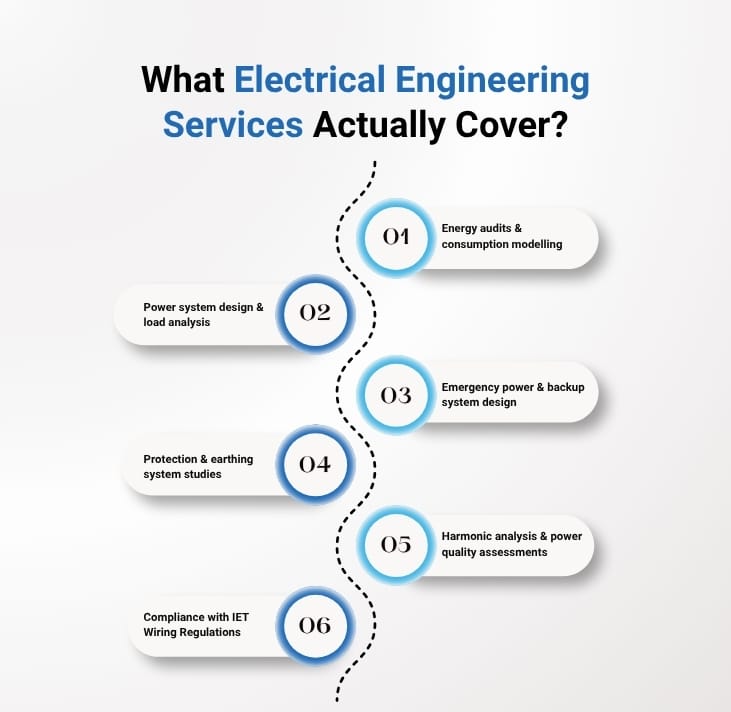
- Power system design and load analysis
- Energy audits and consumption modelling
- High-voltage and low-voltage distribution planning
- Emergency power and backup system design
- Protection and earthing system studies
- Harmonic analysis and power quality assessments
- Compliance with IET Wiring Regulations (BS 7671) and other UK standards
- Condition surveys and asset management reports
| Service Area | Business Benefit | Typical Trigger |
|---|---|---|
| Load Analysis | Prevents overloads and unplanned outages | Expansion or new equipment |
| Energy Audit | Reduces utility bills by 10 to 30% | Rising energy costs |
| Power Quality Study | Protects sensitive equipment | Equipment failures or data loss |
| Earthing and Protection Design | Ensures staff safety and regulatory compliance | New build or refurbishment |
| Emergency Power Design | Maintains operations during grid failure | Business continuity planning |
| Condition Survey | Identifies ageing assets before they fail | Insurance or due diligence |
Power Systems: The Foundation of Business Operations
Most business owners never see their electrical distribution network. It lives in a switchroom, behind locked panels, tucked into a basement or plant room. Out of sight tends to mean out of mind. But that network is the reason your lights turn on, your machines run, and your heating works. When it is not designed properly, or when it has not been reviewed for years, it becomes a liability.Electrical engineers run load flow studies to map how current moves through your network. This tells them where the pressure points are, which cables are running close to their limits, and where a voltage drop is quietly causing problems that nobody has connected to the real cause yet.They also carry out short-circuit analysis. When a fault happens on a live network, your circuit breakers and fuses need to respond fast and correctly. If the protection equipment is not rated for the fault current your system can produce, you are not just looking at a tripped breaker. You are looking at an arc flash, a violent release of energy that can destroy switchgear and seriously injure anyone nearby. Sizing protection equipment correctly is not optional. It is the baseline of a safe system.Energy Management: Cutting Costs Without Cutting Output
Energy bills are one of the few costs that businesses often accept without much scrutiny. They arrive, they get paid, and life moves on. But in most commercial and industrial buildings, there is a meaningful percentage of that bill being wasted, and an engineer can show you exactly where it is going.A proper energy audit looks at your consumption patterns across the whole site. It finds the equipment running outside working hours, the motors drawing full power when they only need half, the lighting left on in spaces that are empty for most of the day. It also identifies opportunities to shift loads to cheaper tariff periods, which alone can cut costs without changing a single piece of equipment.From there, the recommendations tend to follow a familiar pattern:- Fitting variable speed drives (VSDs) on older motors so they only draw the power the process actually needs
- Switching to LED lighting with occupancy and daylight sensors
- Installing power factor correction to reduce reactive power charges from the utility
- Sub-metering individual departments or circuits so you can see where the energy actually goes
- Linking heating, cooling, and ventilation to a building management system (BMS) that responds to occupancy rather than running on fixed timers
| Intervention | Typical Energy Saving | Payback Period |
|---|---|---|
| Variable Speed Drives on motors | 20 to 50% on motor energy | 1 to 3 years |
| LED lighting upgrade | 50 to 70% on lighting energy | 2 to 4 years |
| Power factor correction | 5 to 15% on electricity bills | 1 to 2 years |
| Sub-metering and monitoring | 5 to 20% through behaviour change | Under 1 year |
| BMS integration | 15 to 30% on HVAC energy | 3 to 5 years |
Electrical Safety: A Legal and Moral Obligation
The Electricity at Work Regulations 1989 place a clear legal duty on every employer in the UK. Electrical systems must be maintained in a safe condition. That is not guidance or best practice. It is law, and the consequences of getting it wrong range from regulatory fines to prosecution to someone being seriously hurt on your premises.What many businesses miss is that electrical safety is not just about getting an inspection done every few years and filing the certificate. It is a continuous process that runs through design, installation, daily operation, and eventual replacement. Engineers play a role at every stage:- At design stage: specifying the right level of protection and ensuring the earthing arrangement suits the installation
- At installation: reviewing contractor drawings and being present for key commissioning tests
- During operation: carrying out Electrical Installation Condition Reports (EICR) at the intervals required for your type of premises
- Towards end of life: giving clear advice on when ageing assets need replacing before they become a genuine hazard
Renewable Energy and Low-Carbon Technologies
The shift toward renewable energy is no longer just about sustainability credentials. For most businesses, it is increasingly about cost and resilience. On-site solar, battery storage, and EV charging are becoming standard parts of the electrical strategy, and each one brings engineering complexity that needs to be handled properly.Solar PV systems sound straightforward, but the grid connection is where things get technical. The protection settings, the export limiting arrangements, and the way the system interacts with your existing distribution network all need to be designed by someone who understands the requirements of your Distribution Network Operator (DNO). A system that has not been engineered correctly will trip at the worst moments, or may export power in a way that breaches your connection agreement.Battery energy storage systems add another layer. They sit between your generation, your load, and the grid, and they need to be sized and controlled to do their job without creating new problems. The thermal management of lithium-ion batteries in particular is an area where cutting corners carries real consequences. Good engineering removes that risk before the system is ever switched on.EV charging is growing fast, and the electrical demand it creates can be significant. Fifty employees charging overnight could add 200 kW or more to a site’s peak load. Without a load management strategy built into the design, the incoming supply simply will not handle it.Infrastructure Planning and Future-Proofing
Businesses rarely stay the same size. They take on new premises, add production lines, bring in energy-intensive equipment, or acquire other companies and inherit their buildings. Every one of these changes puts new demand on an electrical infrastructure that was designed for a different set of requirements.A capacity study looks at the current headroom in your system, from the incoming supply at the meter point right through the main switchboard and out to your final circuits. It tells you how much spare capacity you actually have, not how much you think you have, and it maps out the point where your growth plans will run into a constraint.Knowing that in advance is genuinely valuable. An upgrade planned eighteen months ahead of when you need it can be done properly, at a competitive cost, with minimal disruption to operations. The same upgrade done in response to a failure or a blocked planning condition costs more, takes longer, and tends to arrive at exactly the wrong moment.| Business Scenario | Engineering Service Required | Risk if Not Addressed |
|---|---|---|
| Site expansion or new build | Load analysis and distribution design | Overloaded cables, regulatory non-compliance |
| New heavy machinery | Short-circuit and protection study | Equipment damage, arc flash risk |
| Solar PV or BESS installation | G99/G100 connection study, protection design | Grid disconnection, safety hazard |
| EV charging rollout | Load management and supply upgrade study | Supply overload, blown fuses |
| Data centre or server room | Power quality and UPS design | Data loss, equipment failure |
| Building refurbishment | Condition survey and EICR | Hidden faults, insurance invalidation |
Why Smart Businesses Trust Almens Consult
Almens Consult works with businesses that take their electrical infrastructure seriously. The team covers the full range of power, energy, and safety work, from energy audits that identify quick wins on your utility bills, to detailed power system studies for major site expansions, to compliance reviews that give you and your insurers confidence in the condition of your installation. What sets Almens Consult apart is the combination of technical rigour and practical thinking. The engineers understand that recommendations need to work within real business constraints, not just on paper. Whether you are planning something new or trying to get on top of an existing problem, Almens Consult will give you a straight assessment and a clear path forward. Get in touch to talk through what your site actually needs.The Bottom Line on Electrical Engineering for Your Business
Electrical engineering services are not something to think about only when things go wrong. The businesses that get the most value from them are the ones that bring engineers in before the crisis, while there is still time to plan, budget, and act sensibly.The range of what is available is wider than most people realise. A single condition survey can tell you the state of your existing installation. A full energy management programme can cut your bills significantly over several years. The right service at the right time depends on where your business is and where it is heading.What does not change is the underlying principle. Your electrical infrastructure is not a background detail. It is the foundation that everything else runs on. Treat it that way, and it will serve your business reliably for years. Ignore it, and at some point it will remind you, at a time and cost of its own choosing.Frequently Asked Questions
What do electrical engineering services include for businesses?
They cover power system design, energy audits, safety assessments, protection studies, compliance checks, and infrastructure planning. It is a full package, not just fixing what is broken.
Why should a business invest in power system design?
Because a poorly designed power system causes outages, overloads, and equipment damage. Getting it right from the start costs far less than dealing with failures later.
How do variable speed drives help reduce energy costs?
They match motor speed to actual demand instead of running at full power constantly. Most businesses see motor energy savings of 20 to 50 percent after fitting them.
What does an energy audit look for in a commercial building?
Wasted consumption, equipment running outside working hours, poor power factor, oversized motors, and lighting left on in empty spaces. Small findings often add up to significant savings.
How does electrical safety compliance protect my business?
It keeps you on the right side of the Electricity at Work Regulations 1989, protects staff from harm, and protects the business from prosecution, fines, and insurance complications.
Can my current electrical supply handle EV charging for staff?
Probably not without an engineer reviewing it first. Fifty EVs charging overnight can add over 200 kW of demand. A load management strategy needs to be designed before the chargers go in.
When should a business consider a battery energy storage system?
When you have on-site solar generation, high peak demand charges, or need backup power resilience. The sizing and configuration needs proper engineering to work safely and effectively.
How does infrastructure planning save money in the long run?
It identifies capacity limits before they become emergencies. A planned upgrade done 12 months ahead of need costs far less and causes far less disruption than one done in response to a failure.