


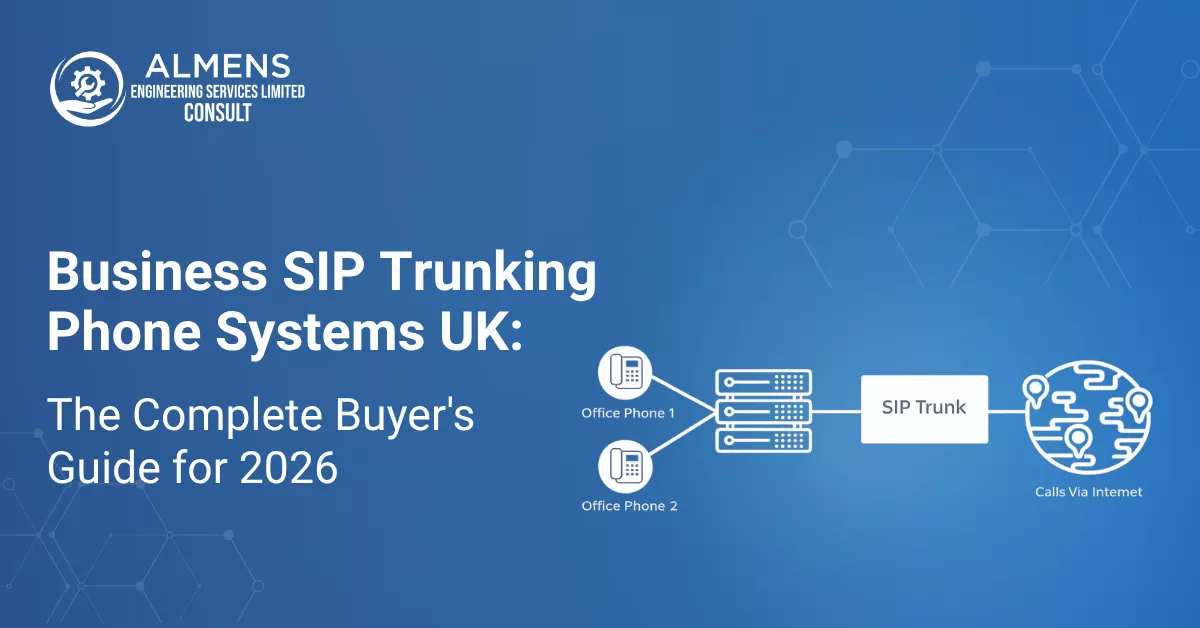

If your business is still paying for ISDN lines, you are most likely overspending on your telephone bill every single month. SIP trunking UK businesses are increasingly adopting this technology to replace expensive, rigid telephone lines with flexible, internet-based connections that cost far less and offer much greater capability. This guide explains what SIP trunking is, how it works, how much it costs, and why making the switch now is the right decision for most UK organisations.
What Is SIP Trunking?
How SIP Trunking Works
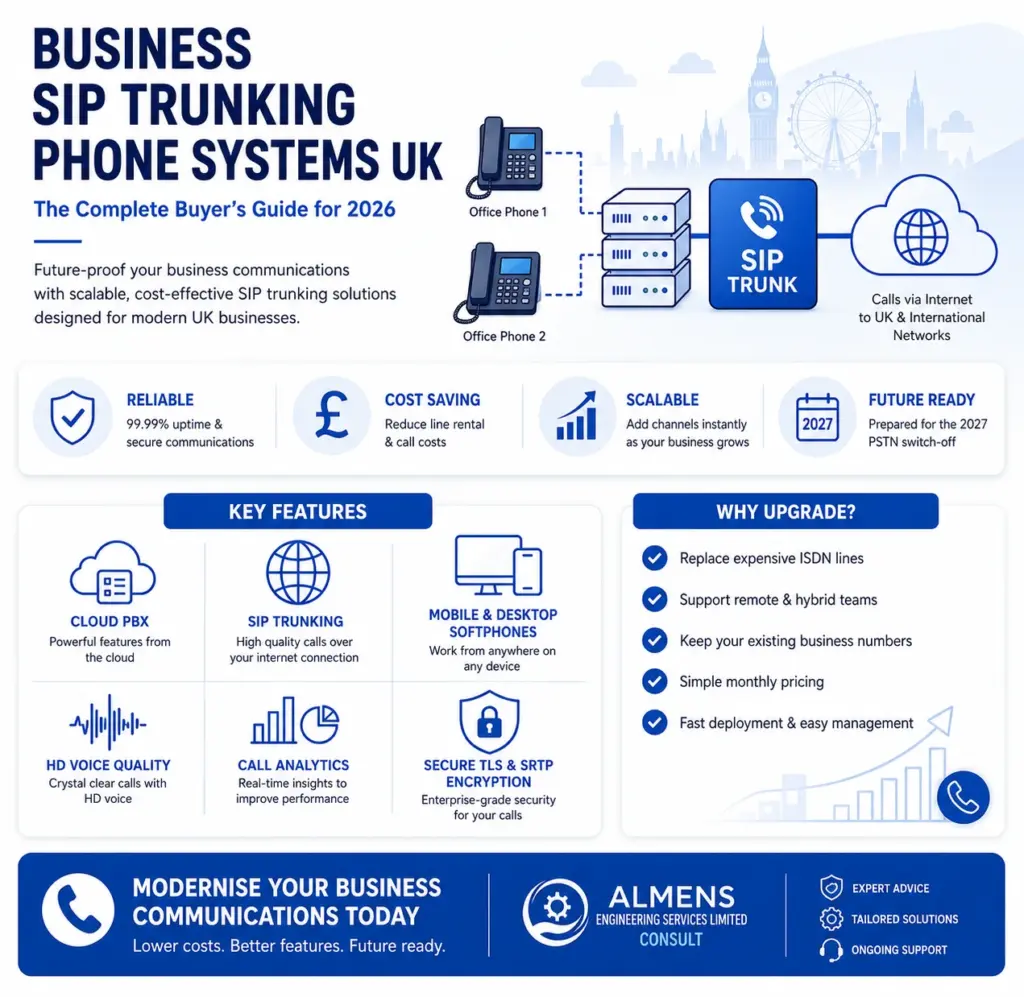
When a call is made from your office, the voice is converted into data packets and sent over your broadband or leased line to your SIP provider’s network. The provider routes the call to its destination, whether that is a UK landline, a mobile number, or an international line. The whole process takes milliseconds and sounds exactly like a normal call, often clearer in fact, because modern HD voice codecs deliver noticeably better audio quality than traditional ISDN.Incoming calls follow the same path in reverse. The provider receives the call and delivers it to your phone system over your internet connection, which rings the correct extension. Neither the caller nor the person answering can tell the difference from a traditional phone call.SIP Trunking vs ISDN
| Feature | ISDN Lines | SIP Trunking UK |
|---|---|---|
| Technology | Physical copper wires | Virtual, runs over internet |
| Simultaneous calls | Fixed number of circuits | Flexible, scale instantly |
| Monthly line cost | Fixed rental whether used or not | Pay per channel, significantly cheaper |
| Call costs | Standard carrier rates | Much lower, especially international |
| Setup time | Days to weeks, engineer visit required | Hours, configured remotely |
| Remote working | Requires complex VPN setup | Works natively from any location |
| HD voice quality | Not available on ISDN | Included as standard |
| PSTN switch-off 2027 | Will stop working entirely | Fully future-proof |
How Much Does SIP Trunking Cost?
SIP trunking UK channels typically cost between £3 and £8 per concurrent channel per month. Compare that to an ISDN30 circuit, which provides 30 channels but costs £400 to £700 per month in line rental alone, before a single call is made. The saving on line rental alone often runs to thousands of pounds every year.| Cost Item | ISDN Typical | SIP Trunking Typical | Annual Saving |
|---|---|---|---|
| 30-channel line rental | £500 per month | £150 per month | £4,200 |
| UK landline calls | 5p per minute | Free or under 1p | Significant |
| UK mobile calls | 12p per minute | 2p per minute | Significant |
| International calls (Europe) | 25p per minute | 1 to 2p per minute | Very significant |
| System maintenance | £200 to £500 per month | Minimal | £2,400 to £6,000 |
Key Benefits for UK Businesses
Lower Costs From Day One
Businesses replacing ISDN with SIP trunking consistently report monthly cost reductions of 40% to 70%. For a business spending £1,000 per month on line rental and calls, that saving can be £500 to £700 every single month.
Flexible, Scalable Capacity
ISDN forces you to pay for a fixed number of circuits regardless of whether you use them all. SIP trunking lets you provision the channels you typically need and scale up instantly during busy periods, paying only for the extra capacity when you actually use it.
Works From Anywhere
Because SIP trunking routes calls over the internet, it is not tied to a physical location. Your team can make and receive business calls from home, from client sites, or from any office, all managed through a single platform without any complex setup.
HD Call Quality
Modern SIP trunks use HD voice codecs such as G.722 that deliver noticeably clearer audio than standard ISDN. Calls are easier to hear, conversations feel more natural, and the overall experience is more professional for both your team and your customers.
Built-In Business Continuity
If your office internet connection goes down, calls can automatically divert to mobile numbers within seconds. Your business stays reachable even during a local outage, something ISDN simply cannot offer.
SIP Trunking and the 2027 PSTN Switch-Off
Openreach has confirmed that the UK’s Public Switched Telephone Network, including all ISDN services, will be permanently switched off by December 2027. Every business still using traditional telephone lines must migrate to a digital alternative before that deadline. SIP trunking UK is the most direct and cost-effective replacement. It operates entirely over internet infrastructure with no dependency on the copper network, making it completely unaffected by the switch-off.
Businesses that switch now avoid the pressure of a last-minute migration and start saving money immediately. Those that wait risk facing reduced provider availability, longer lead times, and potentially no telephone service at all if their ISDN lines fail before migration is complete.
What You Need to Get Started
Setting up SIP trunking requires three things: a compatible telephone system, a reliable internet connection, and a reputable SIP trunk provider.
Most modern IP PBX systems support SIP natively. Older systems that use ISDN interfaces can often be made compatible using a gateway device, and many businesses take the opportunity to move to a fully hosted cloud PBX at the same time, which removes on-premises hardware altogether.
Each simultaneous SIP call uses approximately 100kbps of bandwidth. A standard business fibre connection handles most small and medium-sized businesses comfortably. For high call volumes or where telephone reliability is critical, a leased line provides guaranteed quality of service.
Why Almens Consult Is the Right Partner
When it comes to SIP trunking in the UK, Almens Consult takes a genuinely consultative approach that most telecoms providers simply do not. Their team spends time understanding your current setup, your call volumes, and your business goals before recommending anything. Through established partnerships with leading UK carriers including Miketel Networks and Wavetel Business, Almens Consult delivers competitively priced, enterprise-grade SIP trunking with full end-to-end management. Number porting, system configuration, quality testing, and staff training are all handled by their UK-based team. If you want SIP trunking that works from day one and saves money from month one, Almens Consult is the right partner to call.
Conclusion
SIP trunking UK is one of the most practical and cost-effective upgrades any UK business can make to its telephone infrastructure. It cuts costs, improves call quality, supports flexible working, and prepares your organisation for the mandatory 2027 PSTN switch-off. The savings start immediately, the migration is straightforward with the right support, and the long-term benefits are substantial. There has never been a better time to make the switch.
FAQs
What is the difference between SIP trunking and a cloud phone system?
SIP trunking provides the virtual lines that connect your phone system to the public telephone network. A cloud phone system hosts the entire PBX platform in the cloud. The two work together but serve different functions. SIP trunks can connect to an on-premises IP PBX or a cloud PBX.
How many SIP channels does my business need?
You need one channel for each call your business wants to handle at the same time. Reviewing your current peak simultaneous call volume gives you the right starting point. Most providers also allow occasional bursting above your provisioned channel count for unexpected peaks.
Can I keep my existing phone numbers when switching?
Yes. Number porting transfers your existing business numbers to the new SIP trunking system. Your provider manages the process, and it typically completes within five to fifteen working days for UK numbers. Your customers experience no interruption.
Is SIP trunking secure?
Yes, when set up properly. Reputable providers use TLS encryption to protect call signalling and SRTP to protect the voice media itself. Fraud detection systems also monitor for unusual activity and block unauthorised usage automatically.
How quickly can SIP trunking be set up?
For businesses with an existing SIP-compatible phone system, configuration typically takes one to two business days. Number porting adds five to fifteen working days. A new SIP number can be live within hours. Almens Consult manages the entire process so everything is ready on schedule with no disruption.