




There is a version of this decision that most businesses make quickly and regret slowly. They need an electrical engineering company, they find one that looks professional enough, the price seems reasonable, and they move forward. Then something does not go as expected. A report that cannot be used for compliance purposes because it was prepared incorrectly. A design that does not account for the full load the site needs to carry. A recommendation that turns out to reflect what was easy to sell rather than what the client actually needed.
The pattern is consistent across industries and property types. Choosing an electrical engineering company well requires more thought than most businesses give it. Not because the process is complicated, but because the criteria that actually matter, technical depth, professional independence, regulatory knowledge, communication quality, are not the ones that appear most prominently in a company’s marketing.
This article covers what those criteria look like in practice, and how to apply them to find an electrical engineering company that will actually serve your business well.
What an Electrical Engineering Company Should Deliver
An electrical engineering company is not simply a business that employs electricians. It is a professional organisation that combines technical engineering knowledge with the practical capability to apply that knowledge to real infrastructure challenges.
Electrical engineering services from a competent company cover a wide scope. At the installation and maintenance level, they include consumer unit work, circuit design, wiring installation, fault finding, testing and inspection, and the production of the compliance certificates that UK law requires. At the consulting and analytical level, they include power system studies, energy audits, arc flash assessment, protection coordination analysis, high voltage engineering, and independent review of contractor proposals.
Electrical services in either category should be delivered by people with the qualifications and experience appropriate to the work, with documentation produced correctly and issued to the client for their records.
Knowing what to expect from these different service types helps you evaluate whether a company you are considering can actually deliver what your project needs.
The Types of Work Electrical Engineering Companies Handle
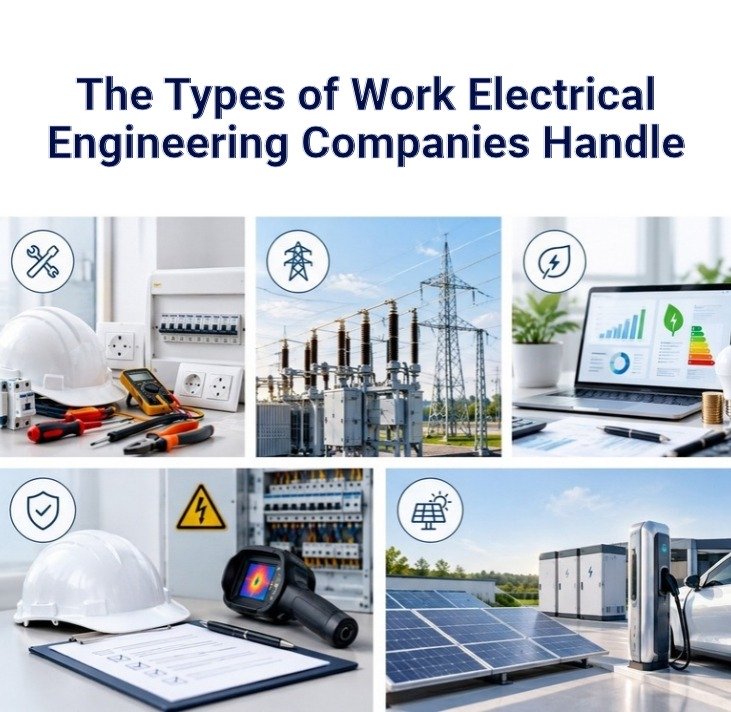
Understanding the range of work that electrical engineering companies handle helps you assess whether a specific firm has the breadth and depth your requirements demand.
Installation and Practical Electrical Services
This covers the physical work of installing, maintaining, and repairing electrical systems. New circuit installation, consumer unit replacement, socket and lighting work, fault investigation, and the full range of testing and inspection services including EICRs fall into this category. The key qualification for companies providing these electrical services is registration with a government-approved competent person scheme.
Power System Engineering
Power system engineering involves the analytical work that assesses whether an electrical distribution network is correctly designed and properly protected. Load flow studies examine whether the system can carry the required demand. Short-circuit analysis confirms that protective devices have sufficient breaking capacity for the fault level at their location. Protection coordination studies verify that when a fault occurs, the right device operates to isolate only the affected section.
These are specialist disciplines that require both engineering knowledge and the use of specialist software tools. Not every electrical engineering company offers them, and the ones that claim to without the underlying capability produce unreliable results.
Energy Management and Auditing
Energy audits examine how an electrical system is actually performing in terms of energy consumption, identify waste, and quantify the savings available from specific improvements. This is one of the most financially rewarding electrical engineering services available to commercial and industrial businesses.
Compliance and Safety Assessment
Compliance work covers the assessment of existing electrical installations against the relevant standards, the identification of deficiencies, and the specification of remedial work. The EICR is the primary compliance document for fixed installations in the UK. Arc flash assessment, high voltage safety audits, and specialist hazardous area assessments are all compliance-related electrical engineering services with their own specific standards and methodology.
Renewable Energy Integration
As solar PV, battery storage, and EV charging become common additions to commercial and industrial properties, the electrical engineering required to integrate them safely and in compliance with UK grid connection requirements has become a significant service category in its own right.
| Service Category | What It Involves | When You Need It |
|---|---|---|
| Installation and electrical services | Physical wiring, testing, EICR | New work, maintenance, compliance inspection |
| Power system engineering | Load flow, fault level, protection studies | Infrastructure expansion, system changes, new loads |
| Energy management | Audit, sub-metering, efficiency engineering | High energy costs, sustainability targets |
| Compliance assessment | EICR, arc flash, HV audit | Regulatory requirement, property transaction, insurance |
| Renewable energy | Solar PV, battery, EV charging integration | Green energy adoption, fleet electrification |
What Makes an Electrical Engineering Company Genuinely Reliable
Professional Qualifications That Match the Work
The qualifications that matter depend on the type of work. For installation and maintenance electrical services, electricians should hold current qualifications such as the City and Guilds 2382 or equivalent, and the company should be registered with NICEIC, NAPIT, or the ECA.
For engineering consultancy work, Chartered Engineer status registered with the Institution of Engineering and Technology or the Engineering Council is the recognised benchmark. This is not a simple membership. It is an independently assessed professional qualification that confirms a level of knowledge and judgement appropriate to the responsibilities of an engineering consultant.
Asking for the qualifications of the specific people who will work on your project is more useful than asking about the company’s general credentials. The person who will carry out the technical work is the one whose competence matters most.
Independence From Equipment Suppliers and Contractors
An electrical engineering company that has financial arrangements with specific equipment suppliers cannot give fully independent advice about equipment selection. One that has commercial relationships with installation contractors cannot give fully independent advice about which contractor to appoint or what scope of work is genuinely needed.
This is not a theoretical concern. It is a practical reality that shapes the advice businesses receive without their awareness. The only protection is to ask directly about these relationships and to engage genuinely independent companies for the advisory work that involves significant financial decisions.
Depth of Regulatory Knowledge
UK electrical engineering operates within a regulatory framework that a competent company knows thoroughly. The Electricity at Work Regulations 1989, BS 7671, BS EN 50110, the Building Regulations, and the various sector-specific standards that apply in healthcare, nuclear, food production, and hazardous area environments are all part of the working knowledge a reliable electrical engineering company applies routinely.
A company that is vague about which regulations apply to your project is not a reliable choice for work where regulatory compliance matters.
Track Record in Your Sector
Sector experience is not the same as general competence. An electrical engineering company with strong experience in retail fit-outs has knowledge of the practical realities of that environment. One with experience in food production facilities understands the hygiene and equipment standards that apply there. One with HV experience in the utilities sector brings a different depth to a substation engineering project than a general consultant.
Ask for specific examples of similar work and for references from clients in comparable sectors. The willingness to provide this information, and the quality of those references when you follow them up, tells you a great deal about the company’s confidence in its own track record.
Common Mistakes Businesses Make When Choosing an Electrical Engineering Company
| Mistake | Why It Happens | Consequence | How to Avoid It |
|---|---|---|---|
| Choosing on price alone | Price is the easiest comparison | Poor quality work requiring expensive correction | Evaluate capability and independence alongside cost |
| Not checking specific qualifications | Assumed to be standard | Work carried out by unqualified persons | Confirm qualifications of individuals, not just company |
| Ignoring independence | Not a question businesses naturally ask | Biased recommendations benefiting the company | Ask directly about supplier and contractor relationships |
| Skipping references | Takes time | No evidence of real project performance | Contact at least one previous client from a comparable project |
| Vague scope definition | Client trusts company to fill in gaps | Disputes about what was included | Define scope clearly in writing before work begins |
| Not reviewing complex proposals independently | Assumes contractor design is correct | Poorly designed installation accepted | Engage independent consultancy to review significant proposals |
How to Evaluate an Electrical Engineering Company Before Committing
The evaluation process does not need to be lengthy, but it needs to cover the right ground. The following questions consistently produce useful information about a company’s capability and approach.
Ask about their experience with projects similar to yours. A specific answer with examples is reassuring. A generic answer about their general capability is not.
Ask which regulations and standards apply to the work you need. A competent company answers this immediately and specifically. A less capable one struggles or generalises.
Ask who will carry out the technical work and what their qualifications are. Not the firm’s general qualifications. The specific person’s.
Ask whether the firm has any financial relationships with equipment suppliers or contractors. An independent firm answers clearly. A firm with something to hide does not.
Ask for references from previous clients on comparable projects. Then actually follow them up.
Ask about the quality checking process before work is issued. A company without one does not apply systematic quality control.
The Importance of Clear Documentation
Good electrical engineering services always produce clear documentation. Compliance reports that are correctly formatted and contain all the information required by the relevant standard. Engineering studies that explain their methodology, state their assumptions, and present their conclusions in a way that informs decisions. Design drawings that carry sufficient information for the work to be carried out correctly and the installation to be maintained properly.
Poor documentation is one of the most consistent signs of an electrical engineering company that is not operating at a professional level. Reports that are generic, drawings that are incomplete, or certificates that are incorrectly completed all create problems downstream that the client has to deal with long after the company has been paid and moved on.
Matching the Right Company to the Right Challenge
Not every electrical engineering company is right for every project. The match between the type of firm and the type of challenge determines whether the engagement goes well.
A business that needs an independent assessment of its electrical infrastructure before a major capital investment should not use the contractor it is considering for the installation. The conflict of interest is too significant.
A property owner who needs a standard EICR for a small commercial premises does not need a specialist HV consultancy. They need a competent registered contractor who carries out EICRs as a routine part of their work.
A manufacturer planning to add significant new production capacity needs a power system study before appointing anyone for the installation work. The study tells them what the installation needs to include. Skipping it and going straight to installation is how businesses end up with infrastructure that cannot support the capacity they planned for.
Getting this match right, between the type of company and the type of challenge, is what separates electrical engineering decisions that go well from those that do not.
How Almens Consult Can Help Your Business
Almens Consult is an independent electrical engineering company that provides commercial, industrial, and infrastructure clients across the UK with the technical expertise and the professional independence that electrical engineering decisions require. The team delivers power system studies, energy audits, arc flash assessments, compliance reviews, high voltage engineering, and specialist advisory support for renewable energy integration. Almens Consult operates without commercial ties to equipment suppliers or installation contractors, which means clients receive electrical engineering services grounded entirely in their own interests. Whether the requirement is a compliance review ahead of a property transaction, an energy audit to identify savings opportunities, a power system study ahead of infrastructure expansion, or independent review of a contractor proposal before a significant commitment is made, Almens Consult brings the qualification, the independence, and the communication quality that a trustworthy electrical engineering company should consistently deliver.
The Right Company Delivers Value That Lasts
Electrical engineering decisions echo through the life of a building or a business. The compliance documentation produced this year will be examined in future transactions. The infrastructure designed or assessed now will serve the organisation for decades. The advice acted on today shapes the cost and reliability of operations for years.
Choosing the right electrical engineering company is therefore not a minor procurement detail. It is a decision with long-term consequences that deserves careful evaluation.
The businesses that invest time in applying the criteria in this guide, checking qualifications, confirming independence, seeking relevant references, and matching the type of company to the type of challenge, consistently make better decisions and achieve better outcomes. The ones that choose quickly on price and familiarity consistently discover, at some point, that the shortcut cost more than the careful process would have.
FAQs
What should I look for when choosing an electrical engineering company?
Look for technical qualifications appropriate to the work, including NICEIC or NAPIT registration for electrical contractors and Chartered Engineer status for consultants. Check for relevant sector experience, genuine independence from suppliers and contractors, clear communication during initial contact, and references from previous clients on comparable projects.
Do all electrical engineering companies offer the same services?
No. Electrical contractors focus on installation, maintenance, and testing. Engineering consultancies focus on design, analysis, and independent advice. Specialist firms cover disciplines such as arc flash assessment, high voltage engineering, or energy management. Match the type of company to the type of work you need.
Why does independence matter when choosing an electrical engineering company?
An electrical engineering company with financial relationships with equipment suppliers or installation contractors cannot give fully independent advice. Their recommendations may be shaped by commercial interests rather than your genuine engineering needs. For significant decisions, independent advice is essential.
How do I know if an electrical engineering company is properly qualified in the UK?
For electrical contractors, check registration with NICEIC, NAPIT, or the ECA. For engineering consultants, check for Chartered Engineer status with the IET or Engineering Council. Ask specifically for the qualifications of the individual who will carry out your work, not just the company’s general credentials.
What electrical engineering services does my commercial property legally require?
The Electricity at Work Regulations 1989 require all electrical systems to be maintained safely. Commercial properties need periodic EICR inspections, typically every three to five years. Licensed premises require annual inspection. Where live electrical work may be carried out, arc flash assessment is required under BS EN 50110. Building Regulations Part P applies to installation work in dwellings.
How much do electrical engineering services cost in the UK?
Installation and maintenance work is typically priced by job or day rate. Engineering consultancy fees range from £500 to £1,500 per day or more depending on specialism. Specific services like EICRs, energy audits, and arc flash assessments are usually quoted as fixed fees based on site size and complexity.
Should I get an independent review of a contractor’s electrical proposal?
For significant projects, yes. An independent electrical engineering consultancy can assess whether the proposed design is appropriate, the specification is correct, and the price reflects a fair scope. This review typically costs a small fraction of the contract value and regularly identifies issues that would have been expensive to resolve after the work was completed.
What documentation should an electrical engineering company provide on completion of work?
The specific documentation depends on the work type. Installation work should produce an Electrical Installation Certificate or Minor Works Certificate. EICR inspection produces an Electrical Installation Condition Report. Engineering studies produce a report stating methodology, findings, and recommendations. All documentation should be correctly completed, signed, and issued to the client for their permanent records.