




Every industrial process, commercial building, and critical infrastructure project depends on electrical systems that have been designed, controlled, and maintained by people who understand both the theory and the reality of what happens when those systems are put to work. The gap between a system that works and one that works reliably, safely, and efficiently over its full operational life is almost entirely determined by the quality of the engineering behind it.
Control and design work within electrical engineering is where that quality is established. It is where the decisions get made about how power flows through a system, how faults are detected and cleared, how processes respond to changing conditions, and how the whole arrangement can be maintained by the people who will manage it for the next twenty years. Get these decisions right and the infrastructure serves the business well with minimal intervention. Get them wrong and the costs, in downtime, maintenance, and eventual redesign, compound with every year the system remains in service.
What Electrical Engineering Services Cover in Control and Design
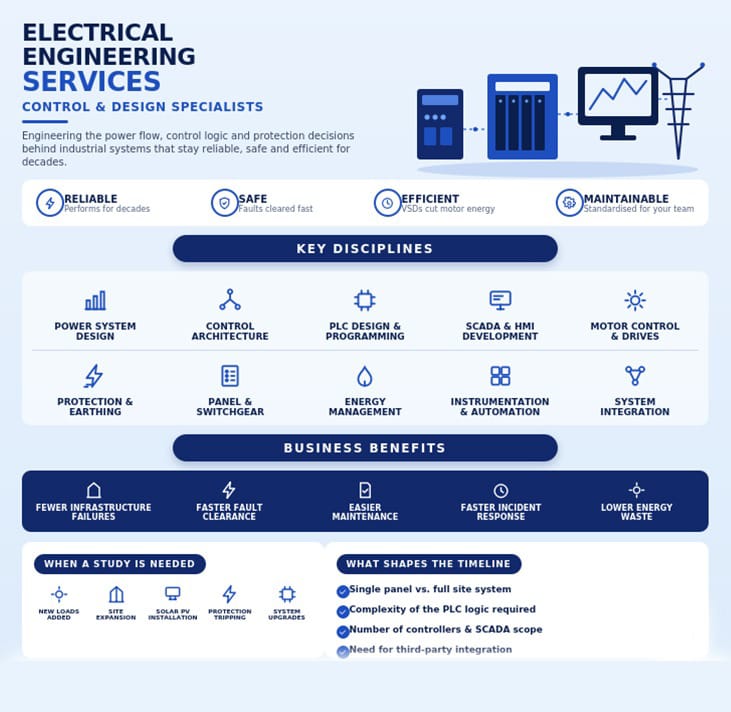
Electrical engineering services in the control and design space sit at the upstream end of the project lifecycle. They are the work that happens before installation begins, shaping everything that follows. For a business investing in new infrastructure, or reviewing existing systems that have reached the limits of their original design, this is where the most consequential decisions are made.
Control and design services typically cover:
- Power system design and load analysis
- Control system architecture and specification
- Programmable Logic Controller design and programming
- SCADA and HMI development
- Motor control and drive system design
- Protection and earthing system design
- Panel design and switchgear specification
- Energy management system design
- Instrumentation and automation design
- System integration across electrical and mechanical processes
Each of these disciplines addresses a specific layer of the electrical system. Together they produce an installation that behaves as intended, responds correctly to both normal and fault conditions, and can be operated and maintained by the people responsible for it without requiring the original design engineers to be present every time something changes.
Power System Design: The Foundation of Everything Else
Good power system design starts with a thorough understanding of what the system needs to do, not just today but across the full expected operational life. Load analysis examines every device, process, and system that will draw power and calculates both the steady-state demand and the transient peaks that occur at startup, during process changes, and under fault conditions.
This analysis informs decisions about the incoming supply, the distribution architecture, the sizing of cables and switchgear, and the specification of protective devices. Getting these parameters right means the system operates within its design limits throughout its life. Getting them wrong means cables and equipment that run hotter than they should, protective devices that operate incorrectly under fault conditions, and infrastructure that needs to be partially rebuilt sooner than anyone expected.
For larger or more complex sites, load flow studies and short-circuit analysis are carried out using specialist power system engineering software. These studies model the behaviour of the electrical network under a range of conditions, identify potential weaknesses before equipment is procured, and provide the data needed to specify protection relay settings with confidence.
Control System Architecture: Where the Process Meets the Electrical System
Control systems are the interface between the electrical infrastructure and the process it serves. They determine how the system starts, stops, responds to setpoints, handles alarms, and protects equipment when something goes outside normal parameters.
The architecture of a control system, the way controllers, sensors, actuators, and communications are arranged and connected, has a direct effect on how reliable and how maintainable the finished installation is. A well-designed architecture separates functions in a way that allows maintenance to happen on one part of the system without taking down the rest. It uses standardised hardware and programming approaches that the people who will maintain the system can work with without specialist knowledge of the original design team’s specific choices.
PLC Design and Programming
Programmable Logic Controllers form the backbone of industrial control systems across virtually every sector. PLC programming in professional electrical engineering services goes well beyond writing the basic control logic. It includes structured programming that is readable and maintainable, alarm management that gives operators useful information rather than a flood of undifferentiated alerts, and data logging that captures the operational history the business needs for maintenance planning, regulatory compliance, and process improvement.
Programming standards matter considerably here. Code that works but is written in a way that nobody other than the original programmer can understand becomes a maintenance liability rather than an asset within a few years of commissioning.
SCADA and HMI Development
Supervisory Control and Data Acquisition systems and their associated Human Machine Interfaces are where operators interact with industrial processes. A well-designed HMI gives the person operating the system a clear, accurate picture of what is happening and makes it straightforward to identify developing problems before they become failures.
Poor HMI design, screens cluttered with unnecessary information, alarms that provide no guidance about what to do, navigation that requires too many steps to reach the most commonly needed functions, is a significant contributor to operator error and slow incident response. Professional SCADA and HMI design as part of a broader electrical engineering services package addresses this by building around how operators actually work rather than what is technically convenient for the designer.
Motor Control and Drive Systems
Motors are the most common electrical load in industrial and commercial settings, and how they are controlled has a significant effect on both energy consumption and equipment life. Direct on-line starting, star-delta starting, and variable speed drives each have different characteristics and suit different applications.
Variable speed drives in particular have become a standard component of energy-efficient motor control design. By matching motor speed to the actual process demand rather than running at full speed continuously, they typically reduce motor energy consumption by twenty to fifty percent in applications where load varies. The electrical engineering design work for a VSD installation covers not just the drive itself but the harmonic effects it introduces into the electrical network, the appropriate filtering or mitigation required, and the interface with the control system.
Protection and Earthing System Design
Protection systems are what stand between a fault in the electrical network and the consequences of that fault going unchecked. Correctly designed protection ensures that when a fault occurs, the right device operates to isolate only the affected part of the system, clearing the fault as quickly as possible without causing unnecessary loss of supply to healthy parts of the installation.
Getting this right requires a protection coordination study that examines every protective device in the system, verifies that the time-current characteristics are correctly set for discrimination, and confirms that each device has sufficient breaking capacity for the fault level at its location.
Earthing and bonding are equally fundamental. They provide the reference point and the fault current path that allows protection devices to operate correctly and prevent dangerous voltage differences from developing across the system. Errors in earthing design are among the most common findings in Electrical Installation Condition Reports and among the most serious in terms of their implications for system safety.
| Design Discipline | Key Engineering Output | Consequence If Poorly Executed |
|---|---|---|
| Power System Design | Load analysis, cable and switchgear specification | Overloaded infrastructure, premature failure |
| Protection Coordination | Relay settings, device selection | Fault not cleared, cascading failure |
| PLC Programming | Control logic, alarm management | Unreliable process, difficult maintenance |
| SCADA and HMI Design | Operator interface, data logging | Operator error, slow incident response |
| VSD and Motor Control | Drive specification, harmonic assessment | Energy waste, equipment damage |
| Earthing Design | Earthing network, bonding connections | Shock risk, protection failure |
Panel Design and Switchgear Specification
Control panels and switchgear assemblies are where much of the design work becomes physical hardware. Panel design as part of a professional electrical engineering service covers the layout of components for electrical safety and accessibility, the specification of correctly rated devices, thermal management to ensure equipment does not overheat in service, and the documentation that allows the panel to be maintained by people who were not involved in its construction.
The specification of switchgear, particularly for medium voltage applications or high fault level environments, requires engineering judgement about type testing, duty cycle, and the specific characteristics of the installation. Switchgear that is under-specified for its environment creates serious risks during fault conditions. Switchgear that is significantly over-specified represents unnecessary capital expenditure.
Energy Management System Design
Energy management has become an increasingly central part of electrical engineering services as businesses face rising energy costs and growing pressure to reduce carbon emissions. An energy management system built into the electrical design from the outset, rather than retrofitted later, provides a significantly better foundation for ongoing optimisation.
The design of an energy management system covers sub-metering at the circuit level to provide visibility of where energy is being consumed, demand management to control peak loads and reduce maximum demand charges, integration with building management systems to coordinate electrical and mechanical energy use, and the data infrastructure needed to turn raw consumption data into actionable management information.
Integration Across Disciplines
The most complex challenge in control and design of electrical engineering services is integration. Electrical systems rarely operate in isolation from mechanical processes, building management systems, production control systems, and enterprise software. The design work that ensures all of these communicate correctly, share data in formats that each system can use, and respond coherently to both normal operations and fault conditions is often where the most experience-dependent engineering judgement is required.
Poorly integrated systems can technically function while being far less useful than their component parts would suggest. They require manual data transfer between systems that should communicate automatically, produce alarms in one system that have no visibility in another where the response needs to happen, and create maintenance challenges that were invisible at commissioning and become progressively more problematic as the systems age.
How Almens Consult Can Help Your Business
Almens Consult provides electrical engineering services across the full range of control and design disciplines, from initial power system design and load analysis through to PLC programming, SCADA development, protection coordination studies, and energy management system design. The team brings together engineering expertise across electrical, controls, and instrumentation disciplines, working on projects ranging from single-site industrial installations to multi-site infrastructure programmes. Almens Consult designs systems that are reliable in operation, straightforward to maintain, and built to perform throughout their full operational life, not just to pass commissioning. Whether the requirement is a new installation, a controls upgrade, or a review of existing systems that are no longer performing as required, Almens Consult brings the technical depth and the practical experience to deliver an outcome the business can depend on.
Design Quality Determines Operational Performance
Every aspect of how an electrical system performs in service traces back to decisions made at the design stage. The reliability of the power supply, the accuracy of the control system, the speed and selectivity with which faults are cleared, the energy efficiency of the installation, and the ease with which the whole arrangement can be maintained, all flow from the quality of the engineering work carried out before a single piece of equipment is installed.
Electrical engineering services that take control and design seriously produce infrastructure that earns its cost many times over through decades of reliable operation. Those that cut corners at the design stage tend to generate those costs back in maintenance, downtime, and eventually in the redesign work that should have been done properly in the first place.
Frequently Asked Questions
What is the difference between electrical engineering services and a standard electrician?
An electrician installs and repairs physical wiring and equipment. An electrical engineer designs the systems behind that work, including control logic, protection coordination, and power distribution architecture. For complex industrial or commercial projects, you need both working together.
What does a control system design service actually involve?
It covers the full specification of how a process is monitored and controlled, including PLC programming, SCADA and HMI development, alarm management, and integration with sensors and actuators. The goal is a system that operators can use confidently and maintenance teams can work on without needing the original designer present.
When does a business need a power system study?
A power system study is recommended when adding significant new loads, expanding a site, installing generation such as solar PV, or when protection devices are tripping unexpectedly. A load flow or short-circuit study confirms whether the existing electrical infrastructure can safely support the proposed changes.
How long does control system design typically take?
The timeline depends on the project scope. A simple control panel with basic PLC programming may take only a few weeks, while a complete site-wide control system with SCADA, multiple PLCs, and third-party integration can take several months from design through commissioning.
What is protection coordination and why does it matter?
Protection coordination ensures that only the protective device closest to a fault operates, preventing unnecessary shutdowns across larger sections of a facility. Without proper coordination, even a minor electrical fault can cause major operational disruption.
Can existing control systems be upgraded without replacing everything?
Yes. Many ageing control systems can be modernised gradually by replacing obsolete PLCs, HMIs, or communication components while retaining equipment that is still reliable. This phased approach often reduces project costs and minimises operational downtime.
What is involved in SCADA and HMI design?
SCADA systems collect, monitor, and display operational data from across an installation, while HMI design focuses on creating intuitive interfaces for operators. Well-designed SCADA and HMI systems reduce operator errors, improve fault response times, and make day-to-day system management more efficient.
How do variable speed drives affect the electrical system beyond the motor itself?
Variable Speed Drives (VSDs) can introduce harmonic distortion into the electrical network, leading to overheating, interference with sensitive equipment, and protection issues. A properly engineered VSD installation includes harmonic analysis and appropriate mitigation measures to ensure reliable system performance.