



The industries that are performing well right now are not simply the ones that invested in the right products or hired the right people. They are the ones that built the right infrastructure to support everything else. Modern manufacturing, logistics, healthcare, utilities, and commercial operations all depend on electrical systems that not only keep the lights on but actively support how the business runs, responds to change, and manages its costs.
What has changed in recent years is the range of what electrical engineering can contribute to industrial performance. The discipline has expanded well beyond the installation and maintenance of cables and switchgear. It now includes energy intelligence, process automation, renewable generation, advanced protection systems, and the integration of electrical infrastructure with the digital systems that modern operations depend on. The industries that understand and use this expanded scope are the ones pulling ahead.
What Modern Electrical Engineering Solutions Look Like
The phrase electrical engineering solutions can sound like a catch-all, and in a sense it is, but that breadth is the point. Modern industrial sites face electrical challenges that span multiple engineering disciplines simultaneously. An energy reduction programme requires load analysis, motor control engineering, and metering infrastructure. A digital transformation project requires control system design, communications infrastructure, and integration between new and legacy systems. A renewable energy installation requires protection engineering, grid connection management, and battery storage design.
Modern electrical engineering solutions for industry cover:
- Intelligent power system design and analysis
- Energy management and efficiency engineering
- Advanced control and automation systems
- Renewable energy integration and storage
- Digital protection and monitoring
- Power quality analysis and mitigation
- High voltage engineering and HV asset management
- Compliance and safety engineering
- Infrastructure lifecycle planning and renewal
Organisations that engage engineering expertise across this full scope, rather than treating each element as a separate procurement, consistently achieve better outcomes because the disciplines are interconnected and the decisions made in one area affect what is possible in others.
Intelligent Power System Design
Designing for Today and Tomorrow
The most forward-looking power system design work in modern industry does not just address current loads. It models future scenarios, including planned production expansion, electrification of processes currently running on gas or diesel, and the integration of on-site generation and storage that changes how power flows through the network.
Load flow analysis using specialist engineering software models these scenarios before equipment is specified or purchased. This prevents the common and costly situation where an expansion project discovers that the existing incoming supply or distribution infrastructure cannot support the additional load, requiring emergency procurement and engineering work under time pressure.
Fault Level Management
As industrial sites add on-site generation, particularly solar PV and battery storage, the fault level at various points in the distribution network changes. This matters because protection devices are specified for a particular fault level. If that level rises above the device’s rated breaking capacity, the device may not safely interrupt a fault when it occurs.
Fault level management as part of intelligent power system design ensures that protection devices are reviewed and re-specified when generation is added to the network, and that the overall fault level is managed within the ratings of the existing switchgear or that switchgear is upgraded where necessary.
Advanced Energy Management
Energy management has moved from being a sustainability initiative to a direct financial tool for industrial operations. With energy prices remaining high and carbon reporting obligations growing, the case for investing in engineering solutions that reduce consumption and improve visibility has strengthened considerably.
Sub-Metering and Real-Time Visibility
You cannot manage what you cannot measure, and most industrial sites cannot measure their energy consumption with enough granularity to make the decisions that reduce it. Sub-metering at the circuit level, connected to an energy management platform, changes this fundamentally.
Real-time visibility into consumption by area, process, or equipment type allows energy managers to identify anomalies that indicate equipment faults or inefficiency, compare consumption against production output to track energy intensity, set and monitor departmental or process-level energy targets, and build the data foundation for further efficiency investment.
Demand Management and Peak Avoidance
Maximum demand charges on electricity bills can be a significant proportion of total energy cost for industrial operations. Engineering solutions that manage peak demand, by sequencing start-up of high-load equipment, temporarily reducing non-critical loads, or discharging battery storage during peak periods, reduce these charges without affecting production output.
This type of demand management requires both the electrical engineering to implement the control logic and the metering infrastructure to give the system the real-time data it needs to make effective decisions automatically.
Control Systems and Industrial Automation
The Next Generation of Industrial Control
Modern industrial control systems do considerably more than start and stop motors. They optimise processes in real time, diagnose developing faults before they cause failures, record operational data for analysis and compliance, and communicate with enterprise systems that manage production scheduling, inventory, and maintenance.
Electrical engineering solutions in the control system space cover the design of distributed control architectures that are resilient to individual component failures, the programming of PLC systems to standards that make the code maintainable by the site’s own engineers, the development of HMI interfaces that genuinely help operators make good decisions, and the integration of new control systems with legacy plant and equipment that the business is not ready to replace.
Predictive Maintenance Through Electrical Monitoring
One of the more significant advances in industrial electrical engineering in recent years is the use of electrical monitoring data for predictive maintenance. Changes in motor current signature, vibration data captured from drive systems, thermal imaging of electrical panels, and partial discharge monitoring on HV equipment all provide early warning of developing faults before they cause unplanned failures.
The engineering solutions that enable this combine instrumentation and monitoring hardware with the data systems and analysis capability to turn raw measurements into actionable maintenance information. The result is maintenance scheduling driven by actual equipment condition rather than fixed time intervals, which reduces both maintenance cost and unplanned downtime.
Renewable Energy and Energy Storage
Solar PV for Industrial Sites
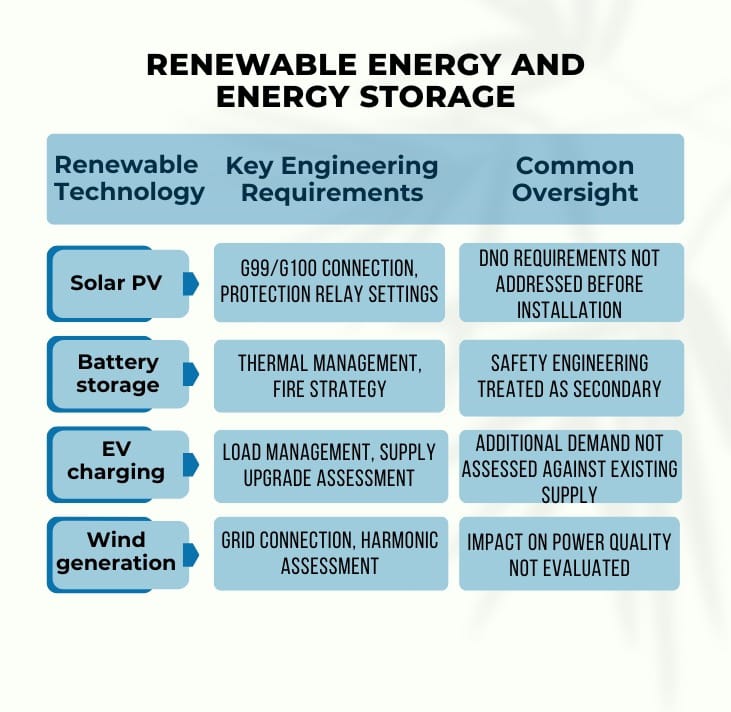
Large industrial rooftops and land parcels represent significant solar generation potential. The engineering work to realise that potential goes well beyond fitting panels. It includes a grid connection study under Engineering Recommendation G99 or G100, protection relay design and settings approved by the Distribution Network Operator, integration with the site’s existing distribution network without compromising protection coordination, and export limiting arrangements that satisfy the DNO’s requirements.Electrical engineering solutions for industrial solar PV also include the energy yield modelling that underpins the business case, the metering infrastructure that demonstrates export and consumption accurately, and the ongoing monitoring that confirms the system is performing as designed.Battery Energy Storage Systems
Battery storage is increasingly a viable and commercially attractive addition to industrial sites, particularly those with on-site generation, significant peak demand charges, or requirements for backup power to critical processes.The engineering complexity of a BESS installation is greater than it might first appear. Battery technology selection, thermal management, protection system design, fire strategy, and integration with both the grid connection and on-site generation all require specialist engineering input. The consequences of inadequate engineering in any of these areas range from poor financial performance to serious safety incidents.| Renewable Technology | Key Engineering Requirements | Common Oversight |
|---|---|---|
| Solar PV | G99/G100 connection, protection relay settings | DNO requirements not addressed before installation |
| Battery Storage | Thermal management, fire strategy | Safety engineering treated as secondary |
| EV Charging | Load management, supply upgrade assessment | Additional demand not assessed against existing supply |
| Wind Generation | Grid connection, harmonic assessment | Impact on power quality not evaluated |
EV Charging Infrastructure
The electrification of industrial vehicle fleets is accelerating, and the electrical infrastructure requirements are significant. A site transitioning twenty or more commercial vehicles to electric may need to add one hundred kilowatts or more of charging capacity. Without a load management strategy and an assessment of the existing supply’s ability to accommodate that demand, the result is either an inadequate charging facility or an overloaded supply.
Engineering solutions for EV charging infrastructure cover load flow analysis to assess supply capacity, load management systems that optimise charging based on vehicle availability and grid tariffs, and the distribution design and switchgear specification needed to deliver power to the charging points reliably.
Power Quality Engineering
Modern industrial processes are increasingly sensitive to power quality. Variable speed drives, precision manufacturing equipment, medical devices, and data systems can all be affected by voltage fluctuations, harmonic distortion, and transient events that would have been tolerated by older, more robust industrial equipment.
Harmonic Analysis
Variable speed drives, UPS systems, and other non-linear loads generate harmonic currents that distort the voltage waveform. This distortion causes overheating in cables and transformers, interference with protection systems, and premature failure of sensitive equipment. A harmonic analysis identifies the sources and magnitude of distortion and specifies the filtering or mitigation required.
Power Quality Monitoring
Deploying power quality monitors at key points in the distribution network provides a continuous record of voltage and current waveforms, harmonic content, and transient events. When equipment fails or processes behave unexpectedly, this data provides the information needed to diagnose the cause rather than simply replacing the failed component and hoping the problem does not recur.
Compliance Engineering for Modern Industry
Compliance is not simply a matter of having the right certificates on file. It is an ongoing engineering responsibility that spans design, installation, operation, and maintenance.
Electrical Installation Condition Reports
The EICR, conducted against BS 7671, is the primary compliance document for fixed electrical installations. Industrial premises should be assessed every three years. The findings provide a structured view of deficiencies in the installation and their relative urgency, allowing the business to plan and budget remedial work rather than responding to failures as they occur.
Arc Flash Assessment
Arc flash remains one of the most serious and most consistently undermanaged electrical hazards in UK industry. The obligation to assess and manage this risk under the Electricity at Work Regulations and BS EN 50110 exists wherever staff or contractors may need to work on or near live electrical equipment. Engineering solutions that address arc flash combine the quantitative assessment of incident energy with practical recommendations for engineering controls and PPE requirements.
High Voltage Safety Management
Sites with HV infrastructure require a level of safety management that goes beyond what applies to LV-only installations. Written safety rules, authorised person schemes, and the engineering documentation that supports safe HV operation are all components of a compliant HV safety management system. Maintaining these as the site and its infrastructure evolve is a continuous engineering responsibility.
Infrastructure Lifecycle Planning
Modern industrial operations increasingly treat their electrical assets with the same lifecycle management discipline they apply to production equipment. A systematic approach to asset condition assessment, remaining useful life estimation, and renewal planning allows the business to manage its electrical infrastructure investment as a planned programme rather than a series of reactive responses to failures.
This approach is particularly valuable for sites with significant legacy infrastructure. A phased renewal programme, driven by engineering assessment of asset condition and risk, is considerably less expensive and less disruptive than the unplanned replacements that follow from failing to plan.
How Almens Consult Can Help Your Organisation
Almens Consult provides electrical engineering solutions for modern industrial and commercial organisations across the full scope of disciplines described in this guide. The team delivers intelligent power system design, energy audits and management strategies, control system engineering, renewable energy integration, arc flash assessment, HV engineering, compliance surveys, and asset lifecycle planning. Almens Consult works independently of equipment suppliers and contractors, which ensures that recommendations reflect what the organisation genuinely needs rather than what generates a sales opportunity for someone else. Whether the requirement is a specific technical challenge, a planned infrastructure project, or a strategic review of electrical assets across a site or portfolio, Almens Consult brings the engineering depth and the operational perspective to deliver outcomes that hold up in practice over the long term.
Engineering Solutions That Drive Industrial Performance
The industries performing best right now are not simply spending more on their electrical infrastructure. They are spending it on the right things, at the right time, with proper engineering behind the decisions. They use energy management as a continuous improvement tool. They integrate automation and monitoring to reduce downtime and maintenance cost. They plan infrastructure renewal before failures force their hand. And they manage compliance as an ongoing responsibility rather than a periodic scramble for documentation.
Electrical engineering solutions that cover this full scope, applied with the right combination of technical expertise and practical judgement, are a genuine competitive advantage for modern industry. The businesses that recognise this are the ones building infrastructure that serves them well for decades rather than struggling with systems that were never quite right from the moment they were installed.