




Hiring the wrong electrical engineering company is a mistake that tends to reveal itself at the worst possible time. During a planned expansion when the infrastructure cannot support it. During an insurance claim when the compliance documentation does not exist. During a safety inspection when deficiencies that should have been caught years ago are finally found.
The UK market has no shortage of electrical engineering companies. What it does have a shortage of is businesses that know how to tell a genuinely capable, reliable firm from one that simply looks the part until the work starts. That gap between appearance and reality is where most bad decisions happen, and it is entirely avoidable with the right approach to evaluation.
This guide gives you a clear, practical framework for finding electrical engineering companies in the UK that will actually serve you well.
What Reliable Electrical Engineering Companies Look Like
Electrical engineering companies in the UK range from sole traders and small specialist consultancies to large multi-discipline firms operating nationally. The reliable ones share consistent characteristics regardless of their size. They are technically competent in the disciplines they claim. They communicate clearly. They know which UK regulations and standards apply to their work. And they deliver what they say they will deliver, on time and to the quality the client needs.
Electrical engineering services from a reliable company go beyond completing a task and issuing an invoice. They include proper engineering analysis, clear documentation of findings and recommendations, and advice that reflects the client’s actual situation rather than the most convenient outcome for the company providing it.
Electrical services at the installation and maintenance level should be carried out by properly qualified professionals registered with appropriate competent person schemes, with documentation issued correctly and retained by the property owner.
These distinctions matter when you are evaluating who to work with.
Understanding the Different Types of Electrical Engineering Companies
Not all electrical engineering companies offer the same services, and understanding the different types helps you identify which kind of firm you actually need.
Electrical Contractors
Electrical contractors plan and carry out the physical installation and maintenance of electrical systems. They employ qualified electricians and electrical engineers who deliver practical work on site. For installation, maintenance, fault finding, and EICR inspection, a registered electrical contractor is the appropriate choice.
Specialist Electrical Engineering Consultancies
Specialist consultancies focus on analysis, design, compliance assessment, and independent advisory work. They carry out power system studies, energy audits, arc flash assessments, protection coordination studies, and high voltage engineering. They do not typically carry out installation work, which means they have no financial interest in the scope or cost of that work.
This independence is the consultancy’s primary value. When you need advice about what your electrical infrastructure needs, that advice is significantly more reliable when it comes from someone who does not also sell the solution.
Design and Build Electrical Engineering Companies
Design and build firms combine engineering design with installation delivery in a single contract. They can offer efficiency and single-point responsibility for straightforward projects. For complex projects involving significant capital investment, the absence of independent engineering oversight can be a disadvantage.
| Company Type | Primary Services | Best Used For |
|---|---|---|
| Electrical Contractor | Installation, maintenance, repair, EICR | Physical electrical work and testing |
| Engineering Consultancy | Design, analysis, advisory, compliance | Independent advice and specialist studies |
| Design and Build | Combined design and installation | Straightforward projects with defined scope |
| Specialist Consultant | Arc flash, HV, power systems, energy | Specific deep-expertise requirements |
The Key Criteria for Evaluating Electrical Engineering Companies
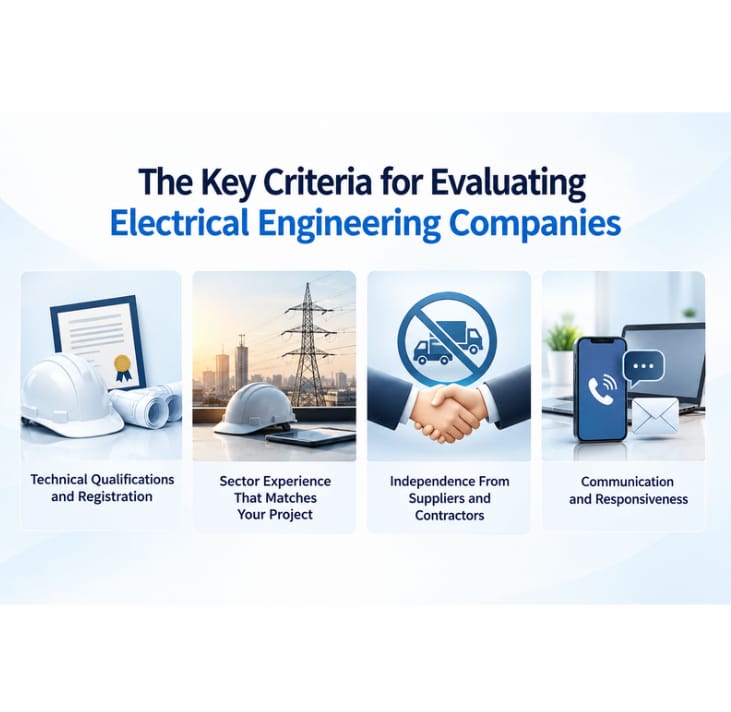
Technical Qualifications and Registration
The starting point for any evaluation is confirming that the company and its engineers hold the qualifications appropriate to the work. For electrical contractors providing electrical services, registration with a government-approved competent person scheme is the baseline requirement. In England and Wales, the main schemes include NICEIC, NAPIT, and the Electrical Contractors Association.
For engineers carrying out design or consultancy work, Chartered Engineer status registered with the Institution of Engineering and Technology or the Engineering Council is the recognised professional benchmark. This is an independently assessed qualification that confirms a level of technical knowledge and professional judgement beyond basic trade competence.
These qualifications do not guarantee a perfect experience. But their absence is a clear signal that a company has not met the standards that the professional bodies for the sector consider appropriate.
Sector Experience That Matches Your Project
Technical qualifications confirm competence in general electrical engineering. Sector experience confirms familiarity with the specific requirements, standards, and practical realities of your industry.
A healthcare project involves electrical engineering services that are governed by specific HTM guidance. A manufacturing project may involve high fault level environments, arc flash risk, and complex protection requirements. A food production facility has particular requirements around equipment standards and hygiene-compatible installation methods.
An electrical engineering company that has worked extensively in your sector will navigate these requirements with the familiarity that comes from experience. One that is encountering them for the first time will take longer, make more mistakes, and need more guidance from you to reach an acceptable outcome.
Independence From Suppliers and Contractors
This is the criterion most often overlooked and one of the most important. An electrical engineering company that has financial arrangements with specific equipment suppliers or installation contractors cannot provide fully independent advice. Its recommendations will be shaped, consciously or not, by the knowledge that recommending a particular product or contractor generates revenue beyond the engineering fee.
For clients making significant financial decisions based on engineering advice, this conflict of interest matters considerably. Ask directly whether the firm has any financial relationships with equipment suppliers or contractors. The answer tells you how much weight to place on their recommendations.
Communication and Responsiveness
A firm that communicates well during the initial stages of an engagement is likely to communicate well throughout it. A firm that is slow to respond, vague in its answers, or reluctant to address direct questions during the evaluation process is showing you how it will behave when your project is underway.
Pay attention to response times, the quality of initial proposals, and how clearly the firm explains what it will do and what it will deliver. These are not secondary considerations. They are reliable predictors of how the project will go.
Knowledge of UK Regulations and Standards
Electrical engineering services in the UK are governed by a framework of regulations and standards that a competent company navigates as a matter of course. These include:
| Regulation or Standard | What It Covers |
|---|---|
| Electricity at Work Regulations 1989 | Legal duty to maintain electrical systems safely |
| BS 7671 IET Wiring Regulations | Technical standard for electrical installations |
| BS EN 50110 | Safe operation of electrical installations, arc flash |
| Building Regulations Part P | Electrical installation work in dwellings |
| DSEAR Regulations 2002 | Hazardous area electrical requirements |
| BS 5839 | Fire detection and alarm electrical supplies |
| BS 5266 | Emergency lighting testing and certification |
| Engineering Recommendation G99/G100 | On-site generation grid connection |
A company that cannot identify which standards apply to your project without prompting is not a reliable choice for work where compliance is a genuine concern.
How to Search Effectively for Electrical Engineering Companies in the UK
Professional Body Directories
The IET, ECA, NICEIC, and NAPIT all maintain searchable directories of registered firms. These are a practical starting point because the listing process filters out firms that have not met the relevant professional standards. Use these directories to build an initial list and then apply the evaluation criteria above to narrow it down.
Sector Referrals
In most industries, professionals who have worked with electrical engineering companies can speak from direct experience about which firms perform well. An operations director in manufacturing who has worked with an excellent power systems consultancy will generally be willing to share that recommendation. These referrals are more valuable than any directory listing because they reflect actual project experience rather than registration alone.
Direct Outreach and Initial Assessment
Once you have a shortlist, contact each firm directly. The quality of that initial interaction is informative. A firm that responds promptly, asks intelligent questions about your requirements, and provides a clear and specific proposal is showing you how it works. A firm that is slow, generic, or evasive is also showing you how it works.
The questions worth asking at this stage include:
- What experience do you have with projects like mine in this sector?
- Who would carry out the work and what are their qualifications?
- Which regulations and standards apply to this type of work?
- Do you have any financial relationships with equipment suppliers or contractors?
- Can you provide references from previous clients on comparable work?
- What does your quality checking process look like before work is issued?
Red Flags to Watch for When Evaluating Electrical Engineering Companies
Some warning signs consistently appear across poor engagements and are worth recognising early.
A company that cannot name the applicable regulations for your project type is not competent in that area, regardless of how well its website presents.
A company that quotes a very low price without a clear explanation of what is included may be planning to add charges later or may be cutting corners that will only become apparent in the quality of the output.
A company that is reluctant to provide references from previous clients has a reason for that reluctance.
A company that dismisses your questions about independence or is evasive about supplier relationships should not be trusted with decisions that involve significant capital expenditure.
A company that cannot describe a quality checking or review process is not applying one.
Matching the Company to the Specific Electrical Challenge
The final consideration is matching the type of electrical engineering company to the specific type of challenge. This sounds obvious but is consistently overlooked.
A business that needs an independent review of its existing electrical infrastructure before a significant expansion should engage an engineering consultancy, not the contractor it is considering for the installation work. A property owner who needs a standard EICR does not need a specialist HV consultancy. A manufacturer planning to add on-site solar generation needs a firm with specific experience in grid connection engineering, not a general electrical contractor who has never worked on a G99 application.
Getting this match right means the company engaged has directly relevant experience, applies the right depth of knowledge, and can be held accountable against an appropriate professional standard for the work type.
How Almens Consult Can Help Your Business
Almens Consult provides independent electrical engineering services to commercial, industrial, and infrastructure clients across the UK. The team carries out power system studies, energy audits, arc flash assessments, compliance reviews, high voltage engineering support, and specialist advisory work for renewable energy integration. Almens Consult operates without financial ties to equipment suppliers or installation contractors, which means every recommendation reflects the client’s genuine needs rather than a commercial interest in a particular product or installation outcome. For businesses that need reliable, independent electrical engineering companies to advise on complex decisions, review contractor proposals, or carry out specialist technical work, Almens Consult provides the qualifications, the sector experience, and the communication quality that a trustworthy engineering partner should consistently deliver.
The Right Company Makes All the Difference
Electrical engineering decisions have long operational consequences. The assessment carried out today will inform investment decisions. The compliance documentation produced now will be examined in future transactions. The infrastructure designed or reviewed this year will serve the business for decades.
Choosing reliable electrical engineering companies is therefore not a minor procurement decision. It is a decision that affects safety, compliance, cost, and the long-term performance of the property and the business within it. The time invested in evaluating companies properly, asking the right questions, checking qualifications, seeking references, and confirming independence, is time that pays back many times over in better outcomes, avoided problems, and engineering advice that can actually be trusted.
FAQs
How do I verify that an electrical engineering company is properly registered in the UK?
Check the relevant professional body directories. For electrical contractors, NICEIC, NAPIT, and the ECA all have online search tools. For engineering consultancies, the IET and Engineering Council maintain registers of Chartered Engineers. Registration should be current, not historical.
What is the difference between electrical engineering companies and electrical contractors?
Electrical contractors primarily carry out physical installation, maintenance, and testing work. Electrical engineering companies, particularly consultancies, provide design, analysis, compliance assessment, and independent advice. The distinction matters when you need advice that is not commercially influenced by the installation work that follows.
Do electrical engineering companies need to be registered to work in the UK?
For work covered by Part P of the Building Regulations, contractors must either be registered with a competent person scheme or notify the local authority for inspection. For engineering consultancy work, there is no mandatory registration but professional body membership and Chartered Engineer status are the recognised indicators of competence.
How much do electrical engineering companies charge for their services?
Costs vary significantly by service type and company. Electrical contractors price by job for installation work. Engineering consultancies typically charge day rates ranging from £500 to £1,500 or more depending on the engineer’s specialism. Power system studies, energy audits, and arc flash assessments are often priced as fixed-fee projects based on site size and complexity.
Can I use the same company for both electrical installation and independent engineering advice?
This can create a conflict of interest. A company that both installs and advises may not be fully independent in its advisory role. For significant decisions, consider separating the installation work from the independent engineering review and engaging different companies for each.
What electrical engineering services are legally required for UK commercial properties?
The Electricity at Work Regulations 1989 require electrical systems to be maintained safely. Commercial properties may need periodic EICR inspection, with inspection intervals depending on the type and use of the property. Licensed premises can have shorter inspection intervals. Additional assessments may also be appropriate where specific electrical hazards, such as arc flash risks, are present.
How do I know if an electrical engineering company is genuinely independent?
Ask directly whether the firm has any financial relationships with equipment suppliers or installation contractors. An independent firm should be transparent about its commercial relationships and explain how these relationships are managed. Clear answers can help you understand whether any potential conflicts could affect its recommendations.
What should I do if I am unhappy with the electrical engineering services provided?
First, raise your concerns directly with the company and allow them the opportunity to address the issue. If this does not resolve the matter, you can contact the relevant professional body, which may be NICEIC, NAPIT, the ECA, or the IET depending on the type of work. If the work has created a safety concern, you can also contact the Health and Safety Executive.