



Short answer: sometimes yes, sometimes no. It genuinely depends on what you already have. Most guides on SIP trunking for business talk about it like it is obviously the right move for everyone. It is not. For some small businesses it is the most cost-efficient decision they make all year. For others, a hosted cloud phone system is a simpler and cheaper route. This guide helps you work out which camp you are in.
SIP Trunking vs a Cloud Phone System: The Actual Difference
People mix these up constantly so worth being clear about it upfront.
SIP trunking is the connection. It replaces your ISDN or analogue phone lines with an internet-based alternative. Your phone system, your PBX box, stays exactly where it is. You are just changing how calls get in and out.
A cloud phone system moves the whole PBX into the cloud. Nothing on site. Your team uses desk phones, apps, or softphones that connect to a hosted platform you manage online.
For a five-person business, which of these you need depends almost entirely on whether you already have a PBX and how your team actually works day to day.
When SIP Trunking Makes Sense for a Small Business
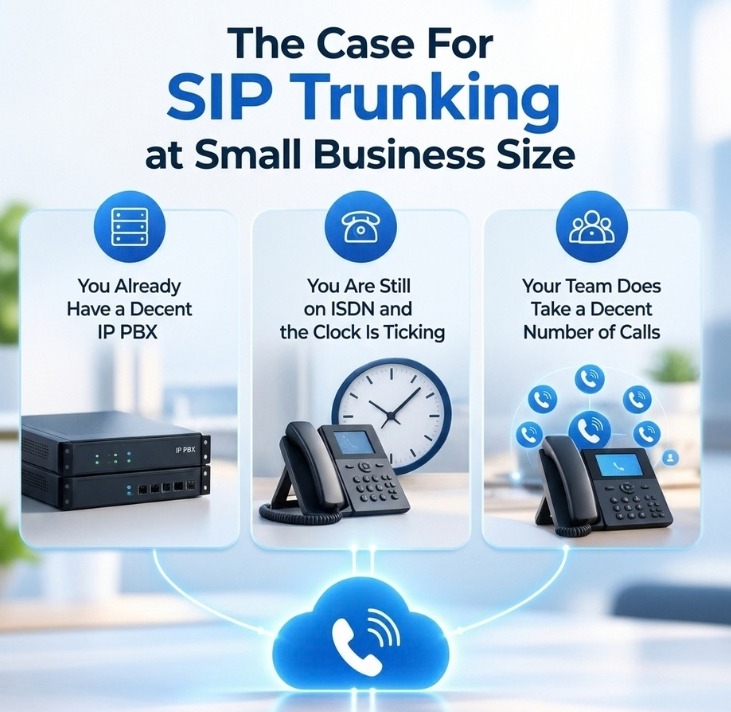
You Already Have a Working IP PBX
If you bought a reasonably modern IP PBX in the last few years, it almost certainly supports SIP trunking. Switching to a hosted system means writing off that hardware investment. SIP trunking keeps your phone system exactly as it is and just replaces the expensive lines feeding into it. Your team does not have to learn anything new. That kind of no-disruption migration is genuinely valuable for a small business where everyone wears multiple hats.
You Are Still on ISDN
Openreach is permanently switching off the UK telephone network in December 2027. If you are on ISDN right now, you have to move off it whether you want to or not. SIP trunking is the most direct replacement, especially if your phone system is otherwise working fine. You keep everything except the ISDN lines, and those go.
Your Team Takes a Reasonable Volume of Calls
A business of five people is not necessarily a business that makes five calls a day. Some small teams are constantly on the phone, running sales calls, taking bookings, handling supplier queries. If there are regularly two or three calls happening at once, sip trunking solutions on a small PBX is worth it. There is a separate guide on working out how many channels you actually need if you want to get into the detail of that.
When a Hosted Cloud System Is the Better Fit
No PBX means adding hardware cost to make SIP trunking work. For five people that changes the maths significantly. A hosted cloud phone system bundles the PBX and the lines into one monthly subscription. Simpler to set up, nothing on site to manage, and often cheaper once you factor in hardware.
The other clear case for hosted is a team that is not all in the same place. Mobile solutions for business that connect to a hosted cloud PBX let every team member use their business number from a phone app wherever they are. SIP trunking into an on-site box does not give you that without additional configuration work. If two or three of your five staff are regularly remote or home-based, hosted usually wins.
| Your Situation | SIP Trunking | Hosted Cloud System |
|---|---|---|
| Have a working IP PBX already | Good fit, keep your hardware | Unnecessary, adds cost |
| No PBX or old one due replacement | Needs hardware added | All-in-one, simpler |
| Whole team office-based | Works well | Works well |
| Mixed remote and office team | Needs extra setup | Built for this |
| High call volumes for team size | Very efficient per channel | Fine either way |
| Minimal call volumes | May not justify it | Simpler to manage |
| Urgently need off ISDN | Most direct path | Also solves this |
What SIP Trunking Saves You
The saving on SIP trunking over ISDN comes from two places: line rental and call costs. ISDN charges you a fixed monthly rental for a fixed number of circuits whether you use them or not. SIP trunking charges you for the channels you actually need and lets you adjust that as your business changes.
UK landline calls on ISDN typically cost several pence per minute. On SIP trunking they are usually included free or cost a fraction of that. Mobile and international calls see similar reductions. The saving varies depending on your current deal and call volumes, but for a business that has been on ISDN for a few years without renegotiating, the difference when they switch is often significant enough to be noticeable on the first bill.
The best way to get an accurate picture is to get a quote based on your actual usage rather than go off general estimates. What Almens Consult does is look at your current call data and give you a specific comparison rather than a ballpark figure.
VoIP Phones on a Small Business SIP Trunking Setup
Whatever you decide, your team will end up using voip phones for business. Modern IP handsets from brands like Yealink and Grandstream are straightforward and not expensive. If you already have IP phones they almost certainly work with SIP trunking directly. If you have old analogue handsets they will need replacing, which is worth factoring in.
The broader shift from traditional lines to VoIP-based systems is happening across the UK regardless of which route you take. SIP trunking and hosted cloud are both VoIP in practice. The question is just where the intelligence sits.
Five Questions Worth Asking Before You Decide
- Do you have a working IP PBX already? If yes, SIP trunking is worth a serious look.
- Is your whole team in one office most of the time? SIP trunking suits this setup better.
- How many calls happen at the same time during your busiest hour? Two or more points to SIP being worthwhile.
- Are you still on ISDN? You need to move either way. SIP is the most direct path if you want to keep your phone system.
- Do you want zero on-site hardware to manage? Hosted cloud removes that entirely.
Why Almens Consult
Almens Consult works with small businesses as well as larger ones and does not push one solution over another. The recommendation depends on what you already have, how your team works, and what you want to spend. They look at your current setup properly before suggesting anything, check compatibility with your existing equipment, and handle the whole migration so nothing goes wrong during the switch. If SIP trunking is right for your business, they sort it. If hosted makes more sense, they do that instead.
Conclusion
SIP trunking for business at small business scale is not automatically the right answer but it is often a very good one. If you have a working IP PBX and want the most cost-efficient way off ISDN, it is hard to beat. If you have no PBX or a team that works across different locations, hosted cloud is the cleaner solution. Either way the 2027 PSTN deadline applies to a business of five just as much as it does to a company of five hundred. Sorting this out now, while there is time to do it properly, is the sensible move.
FAQs
Can a business with two or three staff use SIP trunking?
Yes. There is no minimum size requirement. Whether it makes financial sense depends on whether you have a compatible phone system and how many calls you handle. Very small teams with low call volumes often find a simple hosted setup cheaper and easier to manage.
Do I need a new phone system to use SIP trunking?
Not if you already have a SIP-compatible IP PBX. If your current system only has ISDN ports, you need either a gateway adapter or a replacement. A quick compatibility check before committing saves a lot of hassle later.
How quickly can SIP trunking be set up for a small business?
For a business with a compatible phone system, configuration usually takes one to two working days. Porting existing numbers takes five to fifteen working days for UK geographic numbers. A new SIP number can be live within hours.
What happens if the internet goes down?
A properly set up SIP trunking system includes failover configuration. If the internet drops, calls automatically divert to a mobile number or another destination. Your business stays reachable. This is set up as part of the installation.
How do I find out if SIP trunking would save money for my business specifically?
The most accurate way is to have a consultant look at your current call data and compare it to SIP trunking costs based on your actual usage. General estimates are useful for a rough idea but your specific numbers will give you a much clearer picture of the saving.