




Real estate agents overpay for calls every day. High rental fees, rigid systems, and poor scalability reduce profit margins. Every missed enquiry costs money. Every delayed response weakens trust. Communication sits at the centre of real estate success, yet many agencies still rely on systems built for a different era.
We see this every day. Agents pay high monthly fees for lines they do not fully use. They deal with poor routing. They miss calls during busy hours. This is where SIP trunking for business makes a clear difference. Firms now adopt SIP trunking for business to reduce costs and improve performance. This shift is practical. It solves daily problems that agents face in lead handling, client communication, and team coordination.
Why Real Estate Agents Still Overpay for Calls
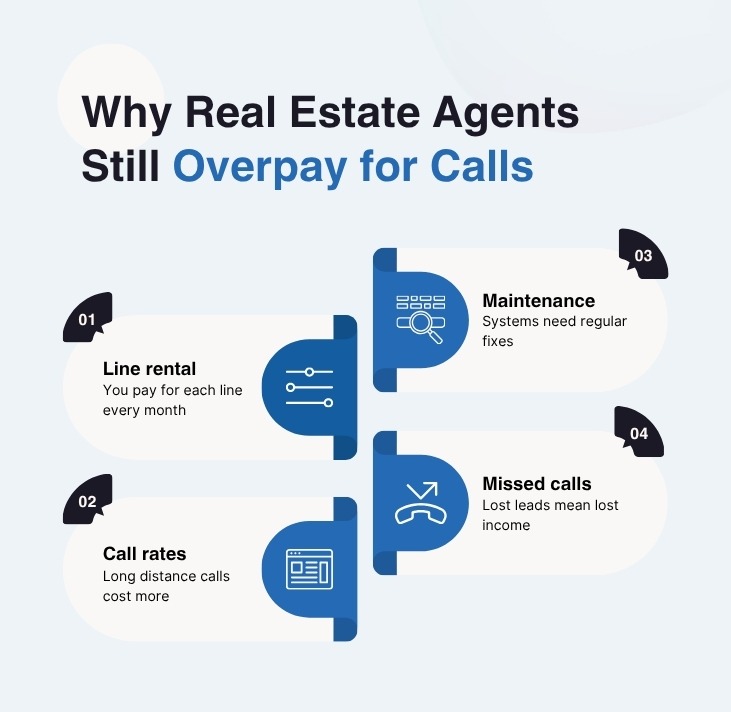
Most agencies do not plan to overspend. It happens because of how traditional systems work. They rely on fixed phone lines. Each line comes with a monthly fee. When a team grows, more lines are added. Costs rise fast. At the same time, these systems do not adjust to daily demand. On a busy day, lines get full and calls drop. On a slow day, those same lines sit idle, but the cost stays the same. Agents also deal with high call charges. This matters when working with overseas buyers or investors. Every long call adds to the bill.
The problem is not one single cost. It is a mix of small expenses that build up over time.
| Area | Problem |
|---|---|
| Line rental | You pay for each line every month |
| Call rates | Long distance calls cost more |
| Setup | Adding new lines takes time and money |
| Maintenance | Systems need regular fixes |
| Missed calls | Lost leads mean lost income |
Many agencies reduce business communication costs instantly with SIP trunking once they identify these hidden expenses.
SIP Trunking for Business vs Traditional Phone Systems
To see the difference clearly, look at how a traditional setup stacks up against SIP trunking for business.
| Feature | Traditional ISDN or Analogue Lines | SIP Trunking for Business |
|---|---|---|
| Infrastructure | Physical copper or fibre circuits | Virtual, runs over your internet |
| Capacity | Fixed blocks, like 30 channels per circuit | Add one channel at a time, instantly |
| Cost model | Line rental plus per minute charges plus maintenance | Per channel fee, often with bundled or lower per minute rates |
| Scalability | Weeks lead time, engineer required | Minutes, self service portal |
| Remote work | Difficult, requires call forwarding or separate lines | Native, works on mobiles, laptops, home offices |
| Disaster recovery | Single point of failure at your office | Built in failover, reroute calls to mobiles or other sites |
| Hardware | PBX, voice gateway, PRI cards, wiring | Minimal, often just a session border controller or none |
The difference is not subtle. You move from a rigid, expensive model to a flexible, pay as you go one.
A Real Example: What One Agency Saved
Before SIP Trunking, their setup looked like this:
| Item | Monthly Cost |
|---|---|
| ISDN30 circuit, 30 channels | £450 |
| Voice gateway maintenance contract | £85 |
| Per minute national calls | £120 |
| Per minute international calls | £90 |
| Additional DIDs, phone numbers | £25 |
| Total | £770 |
They never used more than eight channels at peak. They were paying for twenty two channels they did not need. Their international calls were billed at rates between 15p and 80p per minute.
After switching to SIP Trunking for Business, their cost structure changed:
| Item | Monthly Cost |
|---|---|
| 10 channels, peak capacity plus buffer | £100 |
| Per minute national calls, under 1p | £45 |
| Per minute international calls, 2p to 5p average | £25 |
| DIDs included | £0 |
| Total | £170 |
That is a saving of £600 a month. Over a year, £7,200. That is money that goes back into marketing, property listings, or simply profit.
Choosing the Right SIP Trunk Provider for Your Agency
If you are new to SIP trunking and want a clear breakdown, understanding how it works and how to choose the right provider is the first step. Not all SIP trunk providers are the same. Some are geared toward large enterprises with dedicated IT teams. Others specialise in small businesses. For estate agents, certain factors matter more than others.
| Factor | What to Look For |
|---|---|
| Reliability | 99.99 per cent uptime guarantee. Multiple UK data centres. Automatic failover. |
| Call quality | HD voice support. Low latency routes. Ask for a free trial to test quality. |
| Support | 24/7 support with UK based technical staff. Test their response time. |
| Pricing | Transparent per channel and per minute rates. No hidden setup or maintenance fees. |
| Number porting | Can they take your existing numbers? How long does it take? |
| Security | Toll fraud prevention. Concurrent call limits. International call blocking options. |
| Integration | Does it work with your CRM or property management software? |
Disaster Recovery: Keeping Your Agency Online When Things Go Wrong
One of the hidden advantages of SIP trunking for business is what happens when something goes wrong.- With traditional lines, a storm takes out the copper wires on your street and your phones are dead. You wait hours or days for Openreach to fix them.
- With SIP trunking, you log into your provider’s portal and reroute all incoming calls to mobile phones, home offices, or another branch. Some providers offer automatic failover, so if your office internet drops, calls automatically redirect to numbers you specify.
How Almens Consult Helps You Make the Switch
Almens Consult does the heavy lifting so you do not have to. They start with a full audit of your current setup, digging through your bills, hardware, and call patterns to find exactly where you are overpaying. Then they help you pick a SIP trunk provider that actually fits your agency, not the one with the flashiest marketing. They handle the technical bits: configuring your router, setting up security, testing call quality.During the migration, they manage number porting and stay on standby. If something goes wrong, you are not stuck on hold with a support desk. Almens Consult fixes it. After the cutover, they make sure your team knows how to use the system and that your call quality is solid. The savings from SIP trunking usually cover their fee in the first month or two. Everything after that is pure profit.Stop Overpaying, Start Closing More Deals
Every call counts in real estate. Missing a lead or delaying a response can mean losing a client. Traditional phone systems cost more than they deliver and make it hard to stay connected when your team is busy or working remotely. Switching to SIP trunking for business changes that. It lowers costs, makes call management easier, and lets your agents take calls from anywhere. The result is faster responses, fewer missed leads, and more closed deals.If you want a smooth transition, Almens Consult handles the details so you can focus on selling. Your next phone bill could be half what it is today. Make the call.FAQs
Can I keep my existing phone numbers if I switch to SIP trunking? +
Yes. Your new SIP trunk provider will port your numbers over in 1–2 weeks. Your old lines stay active during that time, so you never lose service. You keep the same number your clients already know.
What internet speed do I need for SIP trunking? +
Each call uses about 100kbps. For ten simultaneous calls, reserve roughly 1Mbps. Most business broadband handles this easily. If your internet is flaky, consider a leased line or a 4G backup for peace of mind.
Will my call quality suffer? +
Not if your network is set up right. Quality of Service (QoS) prioritises voice traffic. With this, call quality is often better than traditional lines. Providers can help you test before switching.
Is SIP trunking secure? +
It is, with a few steps: limit concurrent calls, restrict unnecessary international dialing, and use encryption. Most providers also offer fraud alerts for unusual activity.
How much can I actually save? +
Monthly phone bills often drop 40–70%. For a 5–10 person agency, that is usually £300–£800 a month. Savings depend on current costs and call volume.
Can SIP trunking replace traditional landlines completely? +
Yes. Your phone service runs entirely over the internet. Old ISDN or analogue lines can be cancelled.
Is SIP trunking better than a traditional PBX system? +
Yes. Traditional PBX requires expensive hardware, maintenance, and fixed line bundles. SIP trunking is flexible, costs less, works with remote staff, and offers more features.
How many calls can SIP trunking handle at once? +
Each channel handles one call. Add more channels online as needed. There is no physical limit.
Does SIP trunking improve call quality? +
Yes. Digital transmission removes static or interference. With a stable connection and proper QoS, calls are clear and consistent.
Is SIP trunking suitable for international real estate clients? +
Yes. International rates drop to 1–5p per minute. You can also add local numbers in other countries so clients can call at local rates.