




Here is something that does not get talked about enough. Most UK businesses are paying more for mobile than they need to, sometimes significantly more, and they have no idea. The bills get paid automatically. Nobody questions them. And the tariffs that made sense when they were signed two years ago are now well behind what the market offers today. If your company has more than a handful of SIMs, there is a fair chance your business mobile solutions are costing you more than they should. The good news is that fixing it is not complicated once you know where to look.
Where the Money Actually Goes
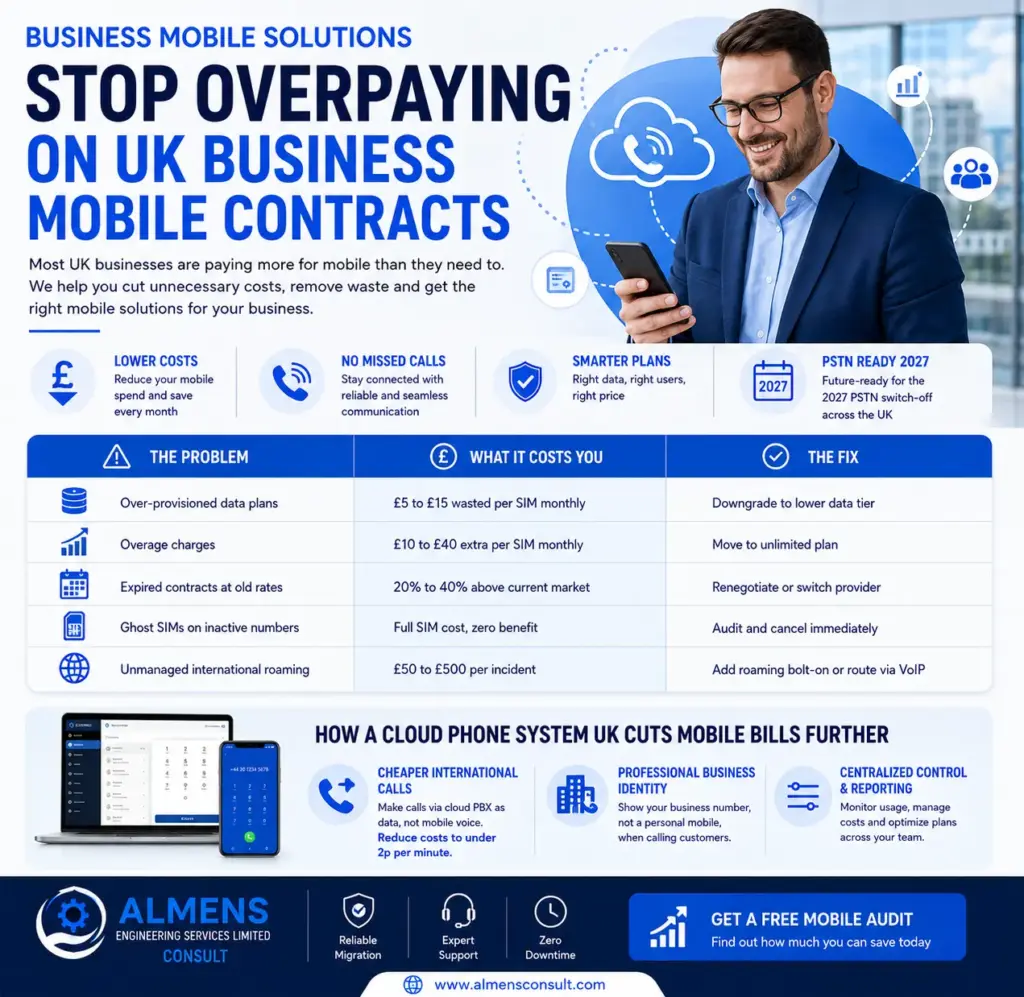
The biggest culprit is usually data. A lot of businesses over-provision, sticking everyone on the same 20GB or 30GB plan because it feels safe, without ever checking how much people actually use. Pull the usage reports for any business account and you will almost always find a chunk of users sitting at 3GB or 4GB a month on a 20GB plan. That gap between what they have and what they use is money straight down the drain.
Then there is the opposite problem. Some users, usually the busier ones out on the road or working from different locations, go over their allowance regularly. Overage charges are expensive per GB, often far more expensive than just moving them to an unlimited plan in the first place. But nobody spots it because the bill just gets paid and filed.
Business mobile solutions that are actually managed properly avoid both of these issues because someone is actively looking at the usage data and adjusting plans accordingly. Without that oversight, the waste just quietly compounds month after month.
Ghost SIMs Are Costing You More Than You Think
Staff turnover creates a problem that very few businesses have a handle on. An employee leaves, their phone gets handed back, but the SIM stays active on the account. Nobody cancels it. The direct debit keeps going out. A business with thirty staff and decent turnover over the past couple of years might have four or five of these sitting on the account right now.
It sounds like a small thing but at fifteen to twenty pounds per SIM per month, that is sixty to one hundred pounds a month going nowhere. One afternoon spent auditing the account and cancelling anything inactive pays for itself many times over.
The Contract Renewal Problem
Mobile network pricing does not stand still. What a provider was charging for 10GB and unlimited calls in 2023 is very different to what they are charging for the same thing in 2026. Better deals exist, newer plans offer more for less, and providers will happily let you keep paying the old rate if you never push back.
Out-of-contract rates are where businesses get hit hardest. When a 24-month contract expires, many accounts simply roll onto a monthly arrangement at the same price. The phone that was subsidised in the tariff is now paid off, but the cost does not come down automatically. This is one of the main reasons business mobile solutions structured properly around SIM-only plans tend to work out cheaper over time. You are paying for data and calls only, not a device you already own.
| The Problem | What It Costs You | The Fix |
|---|---|---|
| Over-provisioned data plans | £5 to £15 wasted per SIM monthly | Downgrade to lower data tier |
| Overage charges | £10 to £40 extra per SIM monthly | Move to unlimited plan |
| Expired contracts at old rates | 20% to 40% above current market | Renegotiate or switch provider |
| Ghost SIMs on inactive numbers | Full SIM cost, zero benefit | Audit and cancel immediately |
| Unmanaged international roaming | £50 to £500 per incident | Add roaming bolt-on or route via VoIP |
How a Cloud Phone System UK Cuts Mobile Bills Further
One thing many businesses overlook is how much they spend on calls made from mobile. Standard mobile voice rates for international calls in particular can be painful, 20p to 50p a minute adds up fast if you have a team that regularly calls clients or suppliers abroad. Integrating your mobiles with a cloud phone system UK changes this completely. Calls go out through the cloud PBX as data rather than through the mobile voice network, which brings the cost down to under 2p a minute for most international destinations.
There is another benefit too. When your team calls through the app, customers see the business number rather than a personal mobile. For companies using a cloud based telephone system UK wide, all calls land on the same platform, get recorded if needed, and appear in the same analytics dashboard. The mobile bill shrinks and the quality of the communication setup actually improves at the same time.
Business SIP Trunking Phone Systems and the Mobile Picture
For businesses that still have a physical office setup, business SIP trunking phone systems work well alongside a mobile strategy. SIP trunking handles the fixed-line calls from the office at a fraction of what ISDN costs. Mobile VoIP through the cloud PBX handles calls on the move. Between the two, most of the expensive per-minute charges that eat into telecoms budgets get eliminated. It is not about choosing one or the other. The best setups use both together.
What London Businesses Need to Think About
For mobile phone business solutions London businesses are dealing with something slightly different to the rest of the UK. Teams in London tend to be more mobile by nature. Account managers covering multiple client sites, field staff moving across zones, executives going between meetings in different parts of the city. For these teams, having a plan that is genuinely unlimited and integrates with a cloud phone system is not a luxury. It is how the working day actually runs.
London also has strong 5G coverage now across most central and inner areas, which means mobile VoIP call quality is consistently good. There is no real excuse for staff to be using personal numbers for business calls when a cloud PBX app on their existing phone handles it cleanly and at much lower cost.
How to Actually Renegotiate Your Mobile Contract
Most businesses wait for the provider to get in touch at renewal. That is a mistake. Providers are not going to volunteer their best pricing unprompted. You have to go and get it.
- Start talking to your provider at least three months before the contract ends
- Get at least two quotes from alternative providers before the conversation
- Bring your usage data to the negotiation so you know exactly what you need
- Ask specifically what new plans have launched since you last signed
- Push for volume discounts if you have ten or more SIMs
- Do not let them roll you onto an out-of-contract rate without a fight
A specialist telecoms partner often gets better rates than businesses going direct because they have commercial agreements with multiple networks. For any business with more than ten SIMs, it is worth having that conversation before the next renewal.
Why Almens Consult
Almens Consult starts with a proper audit of what you are currently spending and where the waste is. They then source competitive plans through their network partnerships, including SIM-only deals and unlimited plans on Vodafone and O2, and manage the whole transition. For businesses that want to go further, they also handle integration between mobile and a cloud phone system UK or business SIP trunking phone systems, so that mobile VoIP is set up properly and the savings on call costs come through from day one. The account is actively managed after setup, not just signed and left, which means the savings hold over time rather than slipping back as plans age.
Conclusion
Overspending on business mobile solutions is genuinely common and genuinely fixable. Run the usage audit, cancel the ghost SIMs, move people onto the right plans, renegotiate at renewal, and look at whether mobile VoIP integration makes sense for your setup. Most businesses that go through this process find savings of 20% to 40% on their mobile spend, and those savings show up on the very next bill. It takes effort to set up properly but once it is done, you stop leaving money on the table every month.