



Walk into almost any small or medium-sized business in London right now and you will find the same thing. Sales calls going out on personal mobiles. Customers saving individual staff numbers rather than the company number. Account managers leaving and taking their entire contact history with them. It is one of those problems that nobody addresses because it crept in slowly and everyone just got used to it. But proper mobile phone business solutions London businesses need are not complicated to set up and the difference they make is immediate. This is why it matters and what fixing it actually looks like.
The Real Cost of Personal Numbers in Business
It does not look like a big deal on the surface. Someone joins the team, they have a phone, they start making calls. Simple. The problem builds over time and you only really see it when something goes wrong.
A customer calls back a number they saved from a previous conversation. The person who answered that call has left. The number is dead or goes to a personal voicemail that nobody checks. The customer gives up and calls a competitor. That is a sale gone, and you will never even know it happened. This plays out in London businesses every day, and it is entirely avoidable with the right business mobile solutions.
There is also the data angle. When employees use personal phones for business calls, those conversations sit outside any system the business controls. No call recording. No visibility in the CRM. No way to review what was discussed with a client if a dispute comes up. For businesses in regulated sectors, that is a compliance issue, not just an inconvenience.
Why London Makes This Problem Worse
Mobile phone business solutions London teams operate in a different environment to most of the UK. London has higher staff turnover than the national average. People move between roles more frequently. Teams are often spread across different locations, working from client sites, different offices across the city, or from home. Field staff, account managers, and client-facing roles are often never at a desk.
All of that movement means the personal number problem compounds faster. In a stable office-based team of ten, the damage from one person leaving with their number is manageable. In a London business where three or four people might move on in a year and each has been giving out a personal mobile to clients, the cumulative impact on customer communication is significant.
What the Fix Actually Looks Like
The solution is not complicated. Every employee gets a business number that lives on a cloud phone system, not on a personal SIM. They can still use their own phone. They install an app, and from that point, their business calls go through the company’s system. The number the customer sees belongs to the business. When that employee leaves, the number stays.
| Personal Mobile for Business | Business Mobile Solution |
|---|---|
| Customer saves personal number | Customer always calls business number |
| Employee leaves, number goes with them | Number stays with the business |
| No call recording possible | Calls recorded automatically if needed |
| No visibility in CRM | Calls logged, screen pop on inbound |
| No professional caller ID | Company number shown to all recipients |
| No out of hours routing | Auto attendant handles calls 24/7 |
| Data sits outside business control | All calls within managed platform |
VoIP Apps: How Your Team Keeps Their Own Phone
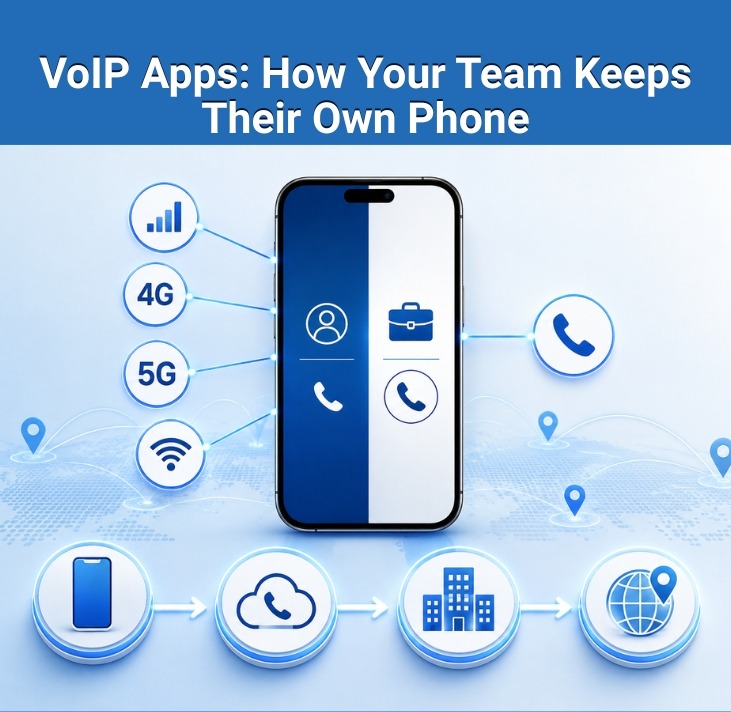
The part that tends to surprise people is that the employee does not need a second handset. A cloud phone system puts a business extension on whatever device they already carry. The app runs on their personal smartphone. When a call comes in on the business number it rings through the app. When they dial out, the recipient sees the business number, not their personal mobile. For the employee it feels the same as using their phone normally. For the business, every call is going through the right system.
This is particularly useful for London teams where people are constantly moving between locations. The app works on 4G, 5G, and Wi-Fi. Someone sitting in a client office in Canary Wharf takes a call the same way as someone at their desk in Mitcham. The customer experience is consistent regardless of where the person actually is.
What About Staff Who Resist the Change
This comes up in almost every business that tries to fix the personal number problem. Some employees push back because they are used to their setup or worried about privacy. The privacy concern is legitimate and worth addressing directly.
A business mobile app does not give the company access to personal calls, messages, or any other content on the phone. The app is separate. The business can see call logs for business calls made through the app. It cannot see anything else on the device. That distinction matters and it is worth explaining clearly when rolling out the change.
For staff who simply prefer a separate work phone, that option exists too. A SIM-only business plan on a basic handset is not expensive and some employees genuinely prefer the separation. The important thing is that the business number lives on the company’s system either way.
SIP Trunking for Businesses With Existing Phone Systems
ome London businesses already have an office phone setup they want to keep. Maybe there is an IP PBX that is still relatively new. In that case, SIP trunking connects the existing system to the cloud without replacing it. Mobile VoIP apps then extend the same business numbers out to mobile workers. The office setup and the mobile setup become part of the same system. Calls can move between them, transfers work, and everything is logged in one place.
The channel sizing for a setup like this is straightforward once you know your peak call volumes. There is a separate guide on working out how many SIP channels your business needs if you want to go into that in detail.
The PSTN Switch-Off Makes This More Urgent
Openreach is switching off the UK’s traditional telephone network by December 2027. Businesses still relying on analogue lines and ISDN will lose their phone service unless they migrate before then. For London businesses using personal mobiles as a workaround for a poor office phone system, now is the right time to sort both problems at once. A cloud based telephone system replaces the ageing infrastructure and gives every team member a proper business number on their mobile at the same time.
What London Businesses Should Do Right Now
- Audit which numbers customers are actually calling to reach your team
- Check how many of those numbers are personal mobiles rather than business lines
- Identify which roles are most affected, usually sales, account management, and field teams
- Talk to a telecoms consultant about a cloud phone system with mobile app integration
- Plan the rollout with clear communication to staff about what changes and what does not
The audit step alone is often eye-opening. Many businesses do not realise how many customer relationships are sitting on personal phones until they look properly. Once you know the scale of it, the decision to fix it becomes straightforward. And the cost of overpaying on mobile contracts tends to drop at the same time because you are moving to a properly managed account rather than a mix of consumer contracts and informal arrangements.
Why Almens Consult
Almens Consult works with London businesses to set up mobile phone solutions that actually fit how city teams operate. That means understanding the mix of office-based and mobile workers, the staff turnover patterns, the client-facing roles, and the existing phone infrastructure before recommending anything. They supply SIM-only plans and unlimited data packages through Vodafone and O2, set up cloud phone systems with mobile app integration, and handle number porting so no business number goes missing in the transition. For businesses that want their team properly set up with business numbers on their mobiles without a complicated rollout, Almens Consult handles the whole thing.
Conclusion
Personal numbers on business calls is one of those problems that feels minor until you see how much it costs. Lost clients, broken contact chains, no call records, compliance gaps. London businesses face all of this more acutely because of how mobile and fast-moving the workforce tends to be. The fix is not expensive or complicated. Mobile phone business solutions London businesses need are available right now, and getting your team onto proper business numbers is one of the most straightforward improvements you can make to how your company communicates.
FAQs
Can employees use their personal phone but still have a business number?
Yes. A cloud phone system app on their personal smartphone gives them a business number without needing a second device. Business calls go through the app. Personal calls use the normal phone dialler. The two are completely separate.
What happens to client relationships when we switch to business numbers?
Existing clients who have saved a personal mobile number will need to update their contact. This is best handled proactively, with a short message from the employee explaining the new business number. Most clients update it without any issue when told clearly.
Does the business get access to personal calls through the app?
No. The app handles business calls only. The business can see logs for calls made through the app. It has no access to personal calls, messages, texts, or any other content on the device.
How quickly can this be set up for a London team?
For a small team the setup can be completed in a day or two. Larger rollouts with number porting from multiple personal numbers take longer, usually one to two weeks. The number porting itself typically takes five to fifteen working days for mobile numbers.
Is this suitable for a business with staff across multiple London locations?
Yes, this is actually one of the biggest advantages. A cloud phone system works across locations, from home, and on the move. Staff in different parts of London are all on the same system, transfers work between them, and the customer always sees the same business number regardless of who answers.